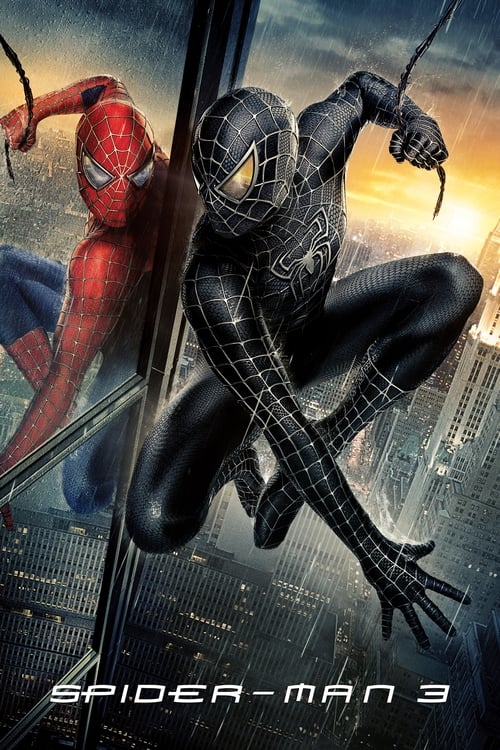
Spider-Man 3 (2007) is a superhero film adapted from Marvel Comics, directed by Sam Raimi and starring Tobey Maguire and Kirsten Dunst. The film is part of the Sony Spider-Verse and was released by Sony Pictures. Runtime: 2h 19m. Rated PG-13. Audience rating: 6.2/10.
What is Spider-Man 3 (2007) about?
Peter Parker discovers a mysterious alien entity called the symbiote that amplifies his dark side, forcing him to confront his greatest enemies — including himself — as Spider-Man faces his toughest test.
Released in 2007, Spider-Man 3 was directed by Sam Raimi and produced under the Sony Pictures banner. The film occupies a significant place within the Sony Spider-Verse — contributing to the ongoing narrative and mythology of that cinematic universe.
The film features lead performances from Tobey Maguire, Kirsten Dunst, James Franco, among others, anchoring a story that adapts characters first brought to life in Marvel Comics. Its source material gives the film a foundation rooted in decades of published storytelling, which Raimi and the creative team interpret through a cinematic lens.
The film's 6.2 audience rating indicates a mixed response. Even so, it holds interest as part of the broader Sony Spider-Verse catalogue and for how it fits into the lineage of Marvel Comics-based cinema.
What happens in Spider-Man 3 (2007)? — Full Plot
New York City, present day. Two years after the events of Spider-Man 2 (2004). Peter Parker (Tobey Maguire) is twenty-three and Spider-Man's career has hit its peak. He has a 4.0 GPA at Columbia. He has been promoted to senior staff photographer at the Daily Bugle. He has a custom-built motorcycle. He's writing a book about Spider-Man. He's in love with Mary Jane Watson. He has been planning a marriage proposal for two months. The film opens on opening night of MJ's Broadway musical debut — she has landed a starring role in a 1940s-jazz-revue called Manhattan Memories. Peter is in the front row holding flowers. He plans to propose after the curtain call. New York City is in love with Spider-Man.
Then a series of bad omens. The reviews of MJ's musical are terrible — Variety calls her singing "adequate at best." She loses the leading-lady role to her understudy and is demoted to chorus. On the same evening, Eddie Brock — a freelance Daily Bugle photographer (Topher Grace, smug, blond, ambitious) — has been competing with Peter for an open staff photographer position. Peter offers Eddie a polite handshake. Eddie pretends to. He immediately fabricates a faked photograph of Spider-Man committing a bank robbery and submits it to J. Jonah Jameson hoping to discredit Peter and win the position. Peter, who took the actual scene-of-crime photographs, exposes Eddie's fraud. JJJ fires Eddie on the spot. Eddie's career is destroyed. He begins blaming Peter.
Then Harry Osborn (James Franco) — Peter's best friend since childhood, the son of Norman Osborn from the first film, who has been quietly grieving his father and harboring resentment that Peter killed him — has finally found the hidden Green Goblin gear his father stashed at the end of Spider-Man 2. Harry has discovered the entire Goblin armory. He becomes the New Goblin — a sleek black-suited update with a snowboard-style hover platform, lighter armor, and a more agile aerial style than his father's pumpkin-bomb-warrior model. The New Goblin attacks Peter on a Manhattan rooftop the night after MJ's opening, mid-celebration. Peter is in civilian clothes. The fight is brutal. Peter and Harry tear up Lower Manhattan in a chase through the financial district. Peter eventually hits Harry hard with a swinging beam. Harry crashes into a brick wall headfirst. He wakes up in a hospital bed with retrograde amnesia — he remembers nothing of his Green Goblin transformation, nothing of his hatred for Peter, nothing of the past two years. He returns to his pre-grief best-friend self.
Flint Marko. A small-time petty thief named Flint Marko (Thomas Haden Church) has just broken out of Riker's Island Prison for the third time and is on the run from NYPD. Marko has a terminally-ill daughter in a hospital who needs an experimental treatment he can't afford. He's robbing pharmacies and bodegas trying to raise the cash. He stumbles into a particle-physics research facility on Long Island just as a beam-line accelerator is firing — his body is caught in the experiment's de-molecularizing wavefront. His molecules disintegrate. He becomes a man made of living sand — a shape-shifting, mass-controlling humanoid who can grow to building-size, dissolve to dust, harden into stone. He flees the facility in shock.
The bigger reveal. Two days later, Peter is called into Captain George Stacy's office at the NYPD. Stacy has new evidence on the 2002 murder of Uncle Ben. The previous burglar Peter chased and killed in the warehouse — the man Peter has spent five years believing was Ben's murderer — was an accomplice. The actual triggerman was Flint Marko, then a small-time getaway driver who panicked when Ben Parker started yelling at him outside the parked Oldsmobile. Marko shot Ben in the chest. Marko has been on the run for five years. Peter's foundational guilt — that his selfishness in letting the burglar past him in the wrestling lobby caused his uncle's death — is now twice as complicated. The actual killer is still alive and now a superpowered fugitive.
The meteorite. A small meteorite from outer space crashes in Central Park near Peter and MJ's bench one evening. They're in Peter's moped helmet-radio range and don't notice it land. The meteorite contains a black, viscous symbiote — an alien parasite that can bond with biological hosts and amplify their physical capabilities and emotional vulnerabilities. The symbiote slips into Peter's moped panel. It rides home with him. That night, while Peter is asleep, the symbiote crawls up his bedspread and onto his Spider-Man suit hanging on a chair. It bonds with the suit. When Peter wakes up the next morning to a Spider-Man emergency, he reaches for the suit and finds it has gone black overnight. He puts it on without thinking. The black suit amplifies his speed by twenty percent. It heals his Spider-Man-related injuries faster. It makes him faster on web-swings. It also brings out the worst impulses in his personality — pride, anger, jealousy, vengeance.
Peter as Black-Spider-Man. The next two weeks of the film play out as Peter slowly losing his moral grounding under the symbiote's influence. He starts dressing himself in all-black emo fashion (the now-iconic side-swept emo bangs and the dance scene that became a generation of internet memes). He treats his Daily Bugle colleagues with arrogance. He flirts aggressively with Gwen Stacy — Captain George Stacy's daughter, a Columbia chemistry student — to make MJ jealous. He humiliates MJ in front of her old jazz-club former employer. He has a meltdown public dance number at a jazz club where MJ is performing as a coat-check girl. He twirls Gwen across the dance floor in slow motion while MJ watches. He hits MJ inadvertently in the climax of the dance when he pushes her aside. The Spider-Man fans have spent the last seventeen years memeing the scene. The film stops being a superhero movie and becomes a possession-by-evil-alien-symbiote drama for an extended forty-minute act.
MJ leaves Peter. Devastated by Peter's transformation, MJ ends the relationship. She doesn't know about the symbiote. She thinks Peter has changed organically into a stranger. Harry Osborn, having recovered his memory from a hallucination of his father Norman in a bedroom mirror — Norman accuses Harry of failing him — sees an opportunity for revenge. Harry comforts MJ at her jazz-club apartment. He makes her dinner. He kisses her. He has been dating Mary Jane for a week when he texts Peter to come to the apartment and shows him the affair. Harry is using MJ to break Peter. MJ is going along with it to make Peter wake up to what he has lost.
Eddie Brock and Sandman. The symbiote has been making Peter aggressive enough that Peter is now actively hunting Flint Marko/Sandman across Manhattan. He confronts Sandman in a subway tunnel and tries to murder him in revenge for Uncle Ben. He flushes Sandman's molecules down a sewer with high-pressure water, dissolving him. Peter believes he's killed Sandman. He goes home in the symbiote-suit and stares at himself in the bedroom mirror. The Peter who would never kill is no longer the man in the mirror. He's becoming a stranger.
Church bell tower. Peter finally realizes the suit is changing him. He goes to a Lower East Side Catholic church bell tower at midnight to try to remove the symbiote. The symbiote, vibrationally allergic to extremely loud high-frequency sound, recoils as the church bell rings overhead. Peter, in pain, pulls the symbiote off of his body in violent ribbons. Below in the church, Eddie Brock — who has been at confession having a moment of crisis after being fired from the Bugle — is praying for revenge against Peter Parker, his hand on the altar. The symbiote falls through the church floor and lands on Eddie's hand. The symbiote bonds with Eddie. Eddie becomes Venom — a black-suited, fanged, tongue-flailing, hyper-aggressive demonic version of Spider-Man with all of Spider-Man's powers plus the symbiote's amplification. Eddie now knows Peter Parker is Spider-Man because the symbiote retained Peter's memories.
Venom and Sandman team up. Eddie tracks down Flint Marko, who has survived the sewer drowning by reforming his molecules at a riverside dump. They form an uneasy alliance. Their plan: kidnap Mary Jane and stage a public execution at a midtown Manhattan construction site to lure Spider-Man into a fight where Venom and Sandman together can kill him. They take MJ. They string her up in a steel cage hanging from a partially-built skyscraper at 67th Street.
Climactic battle. Peter, now in his original red-and-blue suit (the symbiote remnants have been peeled off), webs his way to the construction site. He fights Sandman first — Sandman has grown to fifty feet tall, sand-walking through Manhattan. He's a sympathetic giant now, but the fight is still genuinely dangerous. Harry Osborn — having been confronted by his butler Bernard with the truth that Norman Osborn killed himself with his own glider and Peter had nothing to do with his father's death — flies to the construction site as the New Goblin on his hover-platform. Harry helps Peter. Venom impales Harry through the back with a piece of broken rebar that Harry has just used as a weapon. Harry crashes to the ground bleeding out. Peter pulls his best friend out of the wreckage. "Stay with me. Please. Stay." Harry, dying, holds Peter's hand. "Peter. You're my friend. The best friend. I should have believed you." Harry dies on the construction site floor.
Peter and Venom. Peter, enraged and grieving, attacks Venom alone. He uses sonic vibrations — pieces of construction-site metal pipes struck against each other — to wound the symbiote, weakening it. He pulls Venom off Eddie Brock and traps the symbiote in a pumpkin grenade canister Harry was carrying. Eddie, free of the symbiote, sees the canister and instinctively lunges back into the symbiote one final time, desperate for the high. Peter cannot stop him. Peter throws the pumpkin grenade at the reunited Venom-Brock. Both explode in a single concussive blast. Eddie Brock dies. Venom dies. The construction site collapses.
Sandman's redemption. After the explosions, Peter and Sandman are both on the construction site floor, both wounded, both standing in the rubble looking at each other. Sandman has been reformed into his human shape but is bleeding sand from a half-dozen wounds. He tells Peter the truth about Uncle Ben's death. He had not meant to kill Ben — he had been desperate to steal the car to drive his dying daughter to a hospital that night. He had panicked when Ben yelled. He had not slept in three days. The gun went off in his trembling hand. He has spent the last five years homeless, the last six months as Sandman, trying to get his daughter the treatment she needs. He cries into his hands. Peter, exhausted, looks at Marko. He forgives him. "I forgive you." Sandman dissolves into golden particles and disappears on the dawn wind. Peter is alone in the construction-site dust.
MJ at the jazz club. The film's final scene is Peter visiting MJ at her jazz-club coat-check job at sunrise. He apologizes for everything. He hands her the engagement ring he never gave her. MJ, exhausted, takes the ring without putting it on. She leads him to the empty dance floor. The piano player on the stage plays the same standard he played weeks earlier during their happy date scene. Peter and MJ slow-dance in the empty club. Peter's voice-over plays: "Whatever life holds in store for me, I will never forget these words: with great power, comes great responsibility. This is my gift. My curse. Who am I? I'm Spider-Man." The Spider-Man theme rises. The film fades to black. The Raimi trilogy ends.
Who stars in Spider-Man 3 (2007)?
Find Spider-Man 3 (2007) on Amazon
Watch Spider-Man 3 on Prime Video, browse the original Marvel Comics source material, and discover Blu-rays, soundtracks, and related merchandise on Amazon.
As an Amazon Associate, I earn from qualifying purchases. Link clicks do not affect editorial coverage — see our disclaimer.
What are some facts about Spider-Man 3 (2007)?
Spider-Man 3 released in 2007, placing it within the 2000s era of comic book cinema — a decade that marked the modern superhero cinema revolution.
Directed by Sam Raimi, the film was produced by Sony Pictures and adapts source material from Marvel Comics.
The principal cast features Tobey Maguire and Kirsten Dunst, with key supporting roles played by James Franco, Topher Grace, Thomas Haden Church.
The film belongs to Sony Spider-Verse — Sony Pictures' Spider-Man adjacent film universe.
Spider-Man 3 carries an audience rating of 6.2 — a middling reception but one that hasn't prevented its cultural footprint.
The Marvel Comics source material for Spider-Man 3 has been in continuous publication for decades, giving filmmakers a rich well of storylines, character arcs, and iconography to draw upon.
Films from this era combined practical stunts with the rising CGI industry — many sequences would be impossible with either technology alone.
Spider-Man 3 is catalogued on Movies on Comics among our collection of 164 comic book films spanning 48 years of cinema — from Richard Donner's 1978 Superman to the present day.
Easter Eggs & Hidden Details in Spider-Man 3 (2007)
Sam Raimi's troubled third Spider-Man. The deep cuts include the studio-mandated Venom and the dance-scene cinematic moment that defines the film for many.
Sam Raimi reportedly objected to including Venom in Spider-Man 3. The studio (Sony Pictures) mandated the character based on fan demand. Raimi has said in 2007 commentary that he didn't understand Venom's appeal and didn't want to direct a Venom storyline. The forced inclusion is widely cited as a major factor in the film's tonal incoherence.
Spider-Man 3's middle act features Peter Parker — under the symbiote's influence — strutting down the streets of New York to jazz music. The scene was meant to demonstrate Peter's symbiote-induced ego inflation. Sam Raimi intended the sequence as comedy. The scene was widely mocked as embarrassing and has become one of cinema's most-memed sequences.
Topher Grace — primarily known for sitcom roles — was cast as Eddie Brock / Venom. The casting was widely controversial; fans wanted a more-imposing actor. Grace has since acknowledged the casting was a learning experience. He has not returned to comic-book films.
Thomas Haden Church's Sandman — Flint Marko, the escaped convict whose terminally-ill daughter motivates his crimes — provided the film's emotional center. Church was praised for adding genuine pathos to a generic villain. The character's redemption-arc closing was widely cited as the film's best emotional sequence.
Spider-Man 3's troubled production directly led to the cancellation of Raimi's planned Spider-Man 4 in 2010. Maguire's recurring back issues were the publicly-stated reason; the broader creative-direction conflicts with Sony were also factors. Sony rebooted the franchise as The Amazing Spider-Man (2012).
James Cromwell's Captain Stacy — Gwen's father — was the franchise's first-ever live-action portrayal. The character would later be the franchise's most-celebrated Gwen Stacy death-arc element in The Amazing Spider-Man 2 (2014).
Bryce Dallas Howard's Gwen Stacy — Peter's brief romantic interest — was the franchise's first-ever Gwen Stacy portrayal. The character's death (which would happen in later Spider-Man franchises) was not depicted in this film; she simply leaves at the end.
Spider-Man 3 grossed $895 million globally — the highest-grossing Spider-Man film at the time of release. The commercial success masked the critical disappointment. Many fans consider it the franchise's worst entry.
The black symbiote suit — Peter's costume change throughout the film — was directly modeled on the original Marvel Comics black symbiote suit from the 1980s 'Secret Wars' storyline. The design was widely praised as one of the film's most-effective visual choices.
Tobey Maguire's chronic back issues — established during Spider-Man (2002)'s production — forced creative limitations on his physical performance throughout Spider-Man 3. The issues were widely cited in subsequent franchise behind-the-scenes commentary.

💬 Reader Comments