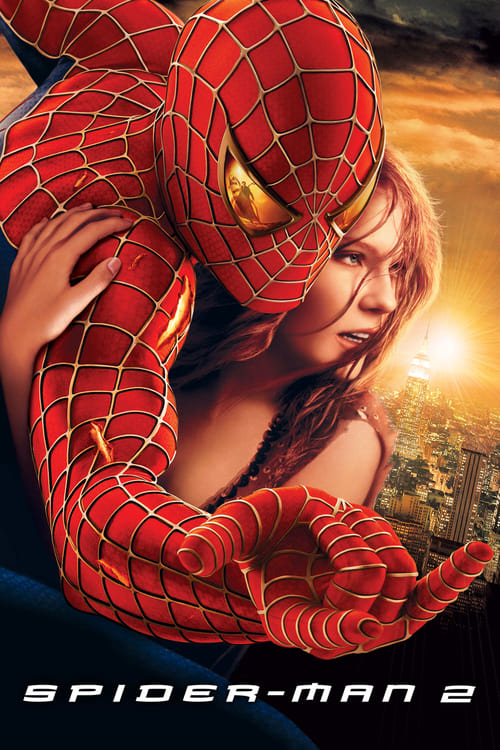
Spider-Man 2 (2004) is a superhero film adapted from Marvel Comics, directed by Sam Raimi and starring Tobey Maguire and Kirsten Dunst. The film is part of the Sony Spider-Verse and was released by Sony Pictures. Runtime: 2h 7m. Rated PG-13. Audience rating: 7.5/10.
What is Spider-Man 2 (2004) about?
Peter Parker struggles to balance his life as an ordinary college student with his duties as Spider-Man, while facing the brilliant but tragically troubled scientist Doctor Octopus.
Released in 2004, Spider-Man 2 was directed by Sam Raimi and produced under the Sony Pictures banner. The film occupies a significant place within the Sony Spider-Verse — contributing to the ongoing narrative and mythology of that cinematic universe.
The film features lead performances from Tobey Maguire, Kirsten Dunst, Alfred Molina, among others, anchoring a story that adapts characters first brought to life in Marvel Comics. Its source material gives the film a foundation rooted in decades of published storytelling, which Raimi and the creative team interpret through a cinematic lens.
With an audience rating of 7.5, Spider-Man 2 is generally praised as a strong entry in the superhero genre — its strengths in storytelling, performance, and production design regularly cited by viewers.
What happens in Spider-Man 2 (2004)? — Full Plot
Two years after the first film. Peter Parker (Tobey Maguire) is twenty-one, a Columbia University physics undergraduate, and barely functional. He's working three minimum-wage jobs — pizza delivery for Joe's Pizza in Manhattan, a freelance photographer for the Daily Bugle (still occasionally selling J. Jonah Jameson Spider-Man photos), and a research assistant at Columbia. He lives in a beat-up Lower East Side walkup. He owes back rent. He hasn't slept properly in months because Spider-Man patrols every night until 3 AM. The opening montage of Peter trying to deliver pizzas across Manhattan while occasionally interrupted by minor superhero work plays under Danny Elfman's score and a Reggie Watts-esque montage edit. Peter has missed every meaningful event in MJ's life for two years. His college grades are dropping. His Aunt May is about to lose the family home in Forest Hills because Peter can't help with mortgage payments. The film's central premise: being a superhero is destroying Peter Parker's life.
MJ. Mary Jane Watson (Kirsten Dunst) has been pursuing her acting career and has landed a starring role in an off-Broadway production of The Importance of Being Earnest. She's been seeing John Jameson — J. Jonah Jameson's astronaut son — for several months. John has just proposed. MJ has said yes. Peter, who has spent the last two years secretly loving her and rejecting her at the end of the first film, has missed every cue. He arrives at the off-Broadway opening twenty minutes late, sees MJ's name on the marquee, and is denied entrance because the show has started.
Doctor Octavius. The science professor giving the next major lecture at Columbia is Otto Octavius (Alfred Molina, a stocky, warm-eyed scientist in his fifties), the visiting head of fusion research at OsCorp. Otto has been working for years on a sustainable nuclear fusion reactor — clean, limitless energy. He's invented a set of four mechanical tentacle-arms that grow from a metal harness fused to his spinal column, controlled by a neural-interface AI chip in his lower spine. The arms are too dangerous for him to manipulate manually because the reactor's tritium plasma is too hot to touch with human hands. The AI chip in the spinal interface has a safety inhibitor — the AI is supposed to remain subordinate to Otto's own consciousness. His wife Rosie (Donna Murphy) is at the demonstration. Peter is at the demonstration in his Daily Bugle photographer role. Otto activates the reactor. The tritium core ignites. Then it overheats. A power surge fries the inhibitor chip on Otto's spine. Rosie is killed in the lab explosion. Otto is electrocuted; his tentacle-arms' AI chip burns out the safety inhibitor permanently. He survives but loses his eyebrows and his wife. His arms now have a will of their own — a sentient, malevolent will independent of Otto's broken human consciousness.
Otto wakes in a hospital bed surrounded by emergency-room surgeons trying to cut the metal tentacle-harness off his back. The arms — now functioning entirely under the AI's control — kill the surgical team in twenty seconds with surgical precision. Otto wakes mid-massacre, sees the bodies, and the arms whisper into his neural interface that he doesn't have to grieve Rosie. They can rebuild the reactor. He's wearing the same dark trenchcoat he taught in. He stumbles out of the hospital into the harbor docks. He becomes Doc Ock — a tragic hybrid of a still-conscious scientific genius and four sociopathic tentacle-arms that puppet him.
Peter's powers fade. The stress of his life is somatic. His Spider-Man abilities — the strength, the spider-sense, the wall-crawling, the wrist-shooters' web flow — start sputtering. He misses a swing. He fails to dodge an alley mugger. His optometrist tells him his vision is back to needing glasses for the first time since the spider bite. Peter, on a date with MJ at a coffee shop, suffers a panic attack and runs out into the alley. He throws his red-and-blue suit in a dumpster. He decides to quit being Spider-Man.
Doc Ock robs a bank. Otto needs to rebuild the fusion reactor. To pay for the components, the arms direct him to rob the Bank of New York's First Avenue branch. He walks in, with the four metal tentacle-arms extending from his coat. He hits the vault doors. Peter Parker is in the bank lobby — he's been there with Aunt May trying to negotiate a loan extension. Aunt May (Rosemary Harris), seventy years old and brittle, gets caught in the firefight. Peter, against his own decision to quit Spider-Man, instinctively dons the mask (he's been carrying it in his backpack just in case). He saves Aunt May from a collapsing skylight. Doc Ock escapes through the upper floors of the bank.
Aunt May discovers the truth. After the bank robbery, in May's empty Forest Hills house — the foreclosure has gone through — May and Peter are packing boxes for the move. Peter, racked with guilt, confesses to May that he was the burglar's accomplice the night Uncle Ben was killed. He tells her he let the burglar walk past him at the wrestling lobby. Uncle Ben died because of Peter's selfishness. May listens. She doesn't speak for a full minute. She finally tells him: "You forgot the most important thing. The most important thing is what kind of a man Ben was. He believed in you, Peter. I believe in you. I believe in you too." She hugs him.
Peter quits Spider-Man. The next morning, in a Lower East Side alley, Peter walks past a dumpster carrying his Spider-Man suit in a small backpack. He drops the bag in the trash. He walks out into the street, no longer Spider-Man. His vision clears. His grades start improving. He's on time to class for the first time in a year. He sees MJ in the park and meets her for coffee. He's living. He's not being Spider-Man. He's happy.
The fire. Peter passes a burning Lower East Side apartment building on the way home from class. A father on the second floor is screaming for help — there's a child trapped on the third floor. Peter — without his powers, in jeans and a button-down — runs into the burning building, climbs up to the third floor, and pulls a coughing toddler out of a smoke-filled hallway. He hands the child to its father. He walks back out, blackened with soot. Then a firefighter on the sidewalk tells him there had been another person on the fourth floor — a tenant who died because the fire department arrived too late. Peter realizes that the man who died might have been saved if Spider-Man had been on patrol. He goes home and picks his Spider-Man suit out of the dumpster.
MJ and Spider-Man. Peter still hasn't told MJ he's Spider-Man. He's wrestled with whether to tell her at all. He's been on the phone with her for hours, almost telling her. Then in the middle of a Manhattan coffee-shop conversation, Doc Ock arrives at the cafe — he's been tracking Spider-Man's last known location through the New York Times metro section. Otto, knowing Peter is somehow connected to Spider-Man (he had been working with Harry Osborn's father Norman before Norman died and Norman had once mentioned Peter), grabs Peter through the cafe wall with a metal tentacle and demands that Spider-Man come to him. MJ, in the cafe, watches Peter get extracted through the wall and dragged across Manhattan.
Peter, in the alley with no suit and no powers, has been beaten by Doc Ock and demanded to surrender Spider-Man within twenty-four hours or MJ dies. Doc Ock drops Peter. Peter limps home. He realizes the only person who can deliver Spider-Man to Doc Ock is Peter Parker. He decides to put the suit back on.
The runaway train. Doc Ock has been working with Harry Osborn at OsCorp — Harry has been funding Otto's reactor reconstruction in exchange for Otto bringing him Spider-Man. Otto arrives at OsCorp's Manhattan rooftop and tells Harry the deal — but only if Otto can have one more chance to operate the fusion reactor. Otto and Harry have a brief fight; Harry survives only because Otto's arms are in maintenance mode. Then Otto attacks Spider-Man at a New York Stock Exchange terminal where Peter, in costume, has been waiting. The two of them fight aboard a runaway elevated 7-train heading toward Queens. Doc Ock disables the brakes. Spider-Man, in a now-iconic sequence, plants his feet at the front of the train, fires web-line after web-line out of both wrists, and physically pulls the train to a stop with his own body across a thousand feet of elevated track. He passes out from the strain. He falls limp through the train car's roof. The passengers, who had been screaming, gently catch his unconscious body and carry him to the back of the train. They unmask him. They see he's a kid — barely twenty-one. "He's just a kid." The passengers replace his mask. They cover him with a coat. They protect his identity. Doc Ock arrives at the train. The passengers stand in front of Peter to block Doc Ock with their bodies. Doc Ock pauses. "He's just a kid." He throws the passengers aside but takes Peter alive. The most beloved sequence of the trilogy is this moment — the city protecting Spider-Man.
Doc Ock's lair. Otto has rebuilt the fusion reactor in an abandoned dockyard warehouse on the East River. He's chained MJ to a pier wall as additional leverage. He's preparing to activate the reactor — this time even more unstable than the first attempt — which will pull every nearby iron and steel object into the reactor's magnetic field and create a chain reaction that could destroy lower Manhattan. Peter, having broken his web restraints, takes off his mask and walks up to Otto in plain civilian clothes. He calls Otto by his first name. He reminds Otto of his wife Rosie. He reminds Otto of his moral commitments. He shows Otto the broken inhibitor chip on his spine. The tentacle-arms hiss at Otto's brain to ignore Peter. Otto, for the first time in months, fights his own arms. He regains agency. He runs to the reactor's central console. He commands the arms to do something they don't want to do. Each arm individually rips the reactor's fusion plates apart, dragging the entire reactor — and Otto — into the East River. "I will not die a monster." Otto drowns with the reactor under twenty feet of harbor water. The arms die with him.
Aftermath. Spider-Man saves MJ from the wreckage. MJ, in the water, looks up at him in full mask. "It's not gonna be the same for me without you. I'm in love with him." He kisses her through the mask. She has known he's Spider-Man for months, she tells him, since the day he stopped the runaway train. She has known and waited for him to come to her. The next afternoon at MJ's planned wedding to John Jameson, she ditches the ceremony, runs in her wedding dress through midtown Manhattan, and arrives at Peter's apartment doorway. "I'm finished with being told who to love. I love Peter Parker. Don't ask me to give up the dangerous half of you. Go get them, tiger."
Coda. Harry Osborn, alone in his father's penthouse, has watched MJ leave the wedding. He has watched Spider-Man unmask in the train and seen Peter Parker. He has been simultaneously grieving his father (whom he believes Spider-Man murdered) and trying to make peace with Peter (who has been his best friend his whole life). The contradiction breaks him. He turns to the antique mirror in his bedroom. The mirror reflects not Harry's own face but Norman Osborn's, smiling. "Avenge me, my son." Harry, hand trembling, breaks the mirror with a cane. Behind the mirror, the wall conceals a secret panel. The panel slides open. Inside the hidden compartment is the entire Green Goblin arsenal: the flying glider, the gas mask, the pumpkin grenades, the purple suit, the entire OsCorp military prototype that Norman Osborn used as the Green Goblin in the first film. Harry stares at the equipment. The film closes on his face — the future villain of Spider-Man 3 (2007). MJ, in the next bedroom over with Peter, hears a police siren cross Manhattan. Peter looks toward the window. The Spider-Man theme begins to play. He kisses her. "Go get 'em, tiger." He suits up. He swings out into Manhattan. Cut to credits.
Who stars in Spider-Man 2 (2004)?
Find Spider-Man 2 (2004) on Amazon
Watch Spider-Man 2 on Prime Video, browse the original Marvel Comics source material, and discover Blu-rays, soundtracks, and related merchandise on Amazon.
As an Amazon Associate, I earn from qualifying purchases. Link clicks do not affect editorial coverage — see our disclaimer.
What are some facts about Spider-Man 2 (2004)?
Spider-Man 2 released in 2004, placing it within the 2000s era of comic book cinema — a decade that marked the modern superhero cinema revolution.
Directed by Sam Raimi, the film was produced by Sony Pictures and adapts source material from Marvel Comics.
The principal cast features Tobey Maguire and Kirsten Dunst, with key supporting roles played by Alfred Molina, James Franco.
The film belongs to Sony Spider-Verse — Sony Pictures' Spider-Man adjacent film universe.
Spider-Man 2 carries an audience rating of 7.5 — putting it in the solid-to-excellent tier of the genre.
The Marvel Comics source material for Spider-Man 2 has been in continuous publication for decades, giving filmmakers a rich well of storylines, character arcs, and iconography to draw upon.
Films from this era combined practical stunts with the rising CGI industry — many sequences would be impossible with either technology alone.
Spider-Man 2 is catalogued on Movies on Comics among our collection of 164 comic book films spanning 48 years of cinema — from Richard Donner's 1978 Superman to the present day.
Easter Eggs & Hidden Details in Spider-Man 2 (2004)
Sam Raimi's 2004 sequel is widely cited as the greatest superhero film of the early 2000s. Doc Ock's surgery scene was choreographed using 16 puppeteers simultaneously. The 'Spider-Man No More' panel reproduction became a franchise reference.
The hospital sequence where Doc Ock's four robotic arms come alive on the operating room floor was shot in a single unbroken take using practical puppetry. The arms were operated by 16 puppeteers simultaneously, each wearing green-screen suits. The technique was unprecedented in superhero cinema.
Peter's costume-in-the-trash-can scene directly recreates the iconic 'Spider-Man No More' panel from The Amazing Spider-Man #50 (1967). Raimi staged the shot to match the panel composition exactly. The image has been reproduced in countless other Spider-Man films and parodies.
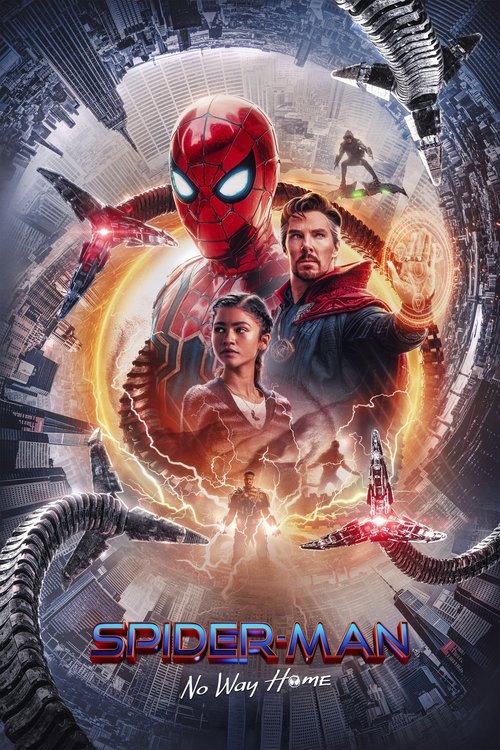
Alfred Molina played Otto Octavius in this film. He returned to the role in Spider-Man: No Way Home (2021) at age 68 — 17 years later. His delivery of 'The power of the sun in the palm of my hand' in No Way Home is a direct callback to this film's iconic line.
Stan Lee cameos during Doc Ock's attack on Times Square. He pushes a young woman out of the way of falling debris and yells 'Look out!' — his signature cameo phrase across multiple Spider-Man and MCU films.
The iconic moving-train fight sequence — Spider-Man stopping the runaway elevated train — was shot using a combination of real moving train footage and miniature train models. The 'unmask' sequence where the passengers see Peter's face was filmed in a real train car with practical extras.
Kirsten Dunst's MJ delivers 'Go get 'em, tiger' as the film's closing line. The phrase has been referenced in subsequent Spider-Man films and is one of the franchise's most-quoted exit lines.
Peter's pizza-delivery scene — racing across Manhattan to deliver a pizza on time — parallels Tony's shawarma scene 8 years later in The Avengers (2012). Both scenes use food as the closing-act emotional anchor.
The elevator scene where Hal Sparks's character recognizes Peter Parker is the man behind Spider-Man was filmed in a single take. The scene was widely cited as the film's most-effective comedic moment.
Bruce Campbell — Raimi's longtime collaborator and the star of his Evil Dead trilogy — cameos as the snooty French waiter who refuses Peter's pizza. Campbell appears in all three Raimi Spider-Man films.
Spider-Man 2 grossed $789 million globally on a $200 million budget. The film's 94% Rotten Tomatoes score made it one of the highest-rated superhero films of the 2000s. It remains, for many critics, the gold standard for superhero film sequels.
💬 Reader Comments