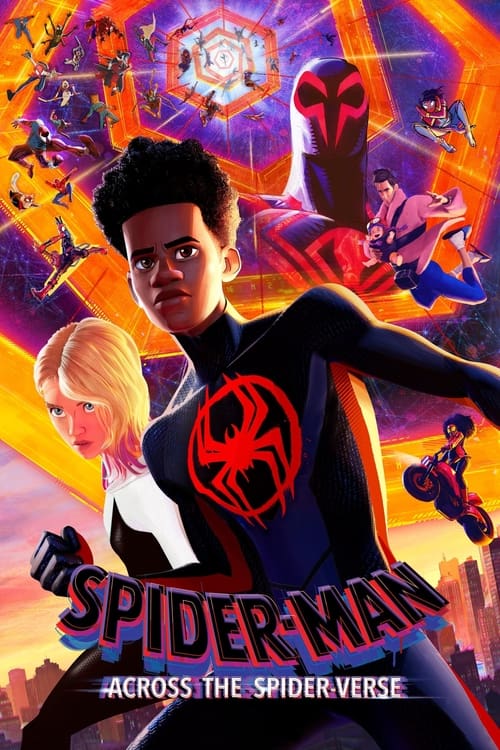
Spider-Man: Across the Spider-Verse (2023) is a superhero film adapted from Marvel Comics, directed by Joaquim Dos Santos, Kemp Powers, Justin K. Thompson and starring Shameik Moore and Hailee Steinfeld. The film is part of the Sony Spider-Verse and was released by Sony Pictures. Runtime: 2h 20m. Rated PG. Audience rating: 8.6/10.
What is Spider-Man: Across the Spider-Verse (2023) about?
Miles Morales catapults across the Multiverse, where he encounters a team of Spider-People charged with protecting its very existence, but faces a conflict over what it truly means to be a hero.
Released in 2023, Spider-Man: Across the Spider-Verse was directed by Joaquim Dos Santos, Kemp Powers, Justin K. Thompson and produced under the Sony Pictures banner. The film occupies a significant place within the Sony Spider-Verse — contributing to the ongoing narrative and mythology of that cinematic universe.
The film features lead performances from Shameik Moore, Hailee Steinfeld, Oscar Isaac, among others, anchoring a story that adapts characters first brought to life in Marvel Comics. Its source material gives the film a foundation rooted in decades of published storytelling, which Thompson and the creative team interpret through a cinematic lens.
A critical and cultural benchmark within the genre, Spider-Man: Across the Spider-Verse is widely regarded as one of the finest comic book films of its era. Its 8.6 audience rating places it among the all-time classics of the medium.
What happens in Spider-Man: Across the Spider-Verse (2023)? — Full Plot
Earth-65 cold open. The watercolor-impressionist universe of Spider-Gwen Stacy (Hailee Steinfeld). She has been Spider-Woman for two years on her home planet. Her father George Stacy, the NYPD captain, has been hunting Spider-Woman across the city — he doesn't know Gwen is the masked hero. Gwen's flashback explains her origin: her best friend Peter Parker had become the Lizard during a desperate experiment to gain Spider-powers and reach her, and Gwen had accidentally killed Peter while saving the city from his rampage. Peter died in her arms. George has been blaming Spider-Woman for the death ever since. Gwen has been hiding the truth from her father. The opening sequence is shot in the film's signature watercolor style — every Spider-Gwen scene's backgrounds are alive and dynamic, painted as if the universe itself is responding to Gwen's emotional state. The Renaissance-Italian Vulture variant arrives. Gwen fights him. Mid-fight, Miguel O'Hara (Oscar Isaac) and Jess Drew (Issa Rae) arrive from another dimension via dimensional-jump device and recruit Gwen into a clandestine multiversal organization called the Spider-Society. Gwen, despite her isolation, accepts the offer.
Brooklyn, sixteen months after the first film. Miles Morales (Shameik Moore), now 16, has been Spider-Man for over a year. He has been balancing his secret identity with his academic schedule at Visions Academy. His father Jefferson Davis has been promoted to Captain at his NYPD precinct, with a celebration ceremony scheduled for that night. Miles is grounded — he had been at a Spider-Man rescue and missed a parent-teacher meeting. He's working through his sketchbook in his bedroom when his old uncle Aaron Davis (Mahershala Ali, the deceased uncle from the first film, returning in posthumous flashback footage Miles is reviewing in a video file). Miles has been mourning Aaron for over a year.
The Spot. A small petty criminal in a white-and-black-spot-covered jumpsuit attacks an ATM in midtown Manhattan. Spider-Man arrives. The Spot (Jason Schwartzman, in voice work) introduces himself — Dr. Jonathan Ohnn, a former Alchemax Industries scientist who had been transformed into a being made of dimensional-jump portals when the collider exploded at the end of Into the Spider-Verse (2018). Each spot on his body is a dimensional aperture — he can transport his hand into a spot on his body and have it emerge from another spot in another dimension simultaneously. He's been collecting Spot-portals across the multiverse for two years and his powers have been growing. He blames Miles for the collider explosion (which had been Kingpin's doing, but the Spot rationalizes Miles as responsible). The Spot is initially a goofy nuisance villain. Then his powers escalate.
Mumbattan. Spider-Gwen arrives in Brooklyn to recruit Miles for the Spider-Society. Miles, surprised but happy, follows her through a dimensional portal. They emerge in Mumbattan — Earth-50101, a hybrid Mumbai-Manhattan urban environment with Indian architectural and cultural details fused into NYC's grid layout. The dimension's resident hero is Pavitr Prabhakar (Karan Soni), India's Spider-Man Boy, age 19, with a cheerful demeanor and a girlfriend named Gayatri (the daughter of his uncle Police Inspector Singh). Miles meets Pavitr just as the Spot arrives in Mumbattan to drain energy from Mumbattan's central power station. Gwen, Miles, and Pavitr fight the Spot together in a five-minute Mumbattan set piece that destroys half the city's central monument. The Spot weaponizes a dimensional-portal-merged blow that begins to amplify his powers exponentially.
Spider-Society. After the fight, Gwen takes Miles to Nueva York — Earth-928, a futuristic cyberpunk version of New York at year 2099 — where Miguel O'Hara has established the Spider-Society's headquarters. The Spider-Society contains hundreds of Spider-Man variants from across the multiverse — every kind of Spider-Man: a Spider-Punk teen variant Hobie Brown (Daniel Kaluuya), a pregnant Spider-Woman Jess Drew, a child Spider-Bot variant, an Indigenous Spider-Man, a Lego-Movie-style Lego Spider-Man, a futuristic robotic Spider-Man, dozens of others. The Society's mission: maintain dimensional stability by ensuring every Spider-Man variant in every reality experiences the necessary Canon Events that define a Spider-Man's identity.
Canon Events. Miguel explains the Society's foundational theory to Miles. Every Spider-Man variant in the multiverse follows the same cosmic narrative pattern. Each Spider-Man, at a specific point in his life, must experience a Canon Event — a specific tragic loss (a parent figure or a captain figure) that defines them as Spider-Man. Uncle Ben's death is the canonical Canon Event of Earth-616. Captain Stacy's death is Earth-65's. Captain Singh's death (Pavitr's uncle in Mumbattan) is Mumbattan's. Miguel claims that interfering with a Canon Event in any reality causes dimensional instability — the universe shatters because its narrative integrity has been corrupted. The Spot is a former version of this kind of integrity-breach; he was a side-effect of Kingpin's collider, an anomaly that doesn't fit the universe's pattern. Miguel's job is to ensure all Canon Events happen on schedule. The Spider-Society watches every Spider-Man for free will so they don't try to save their universes' captain figures.
Miles's canon event. Miguel reveals to Miles his specific Canon Event. Jefferson Davis — Miles's father, NYPD Captain — is destined to die on a particular Brooklyn rooftop in three days. Miguel calls this the Canonical Death of the Captain — every Spider-Man in every reality has a similar event, and Miles must allow his father to die. If Miles saves his father, the universe will dissolve. Miguel demands Miles accept the loss. Miles refuses immediately. "I'm not gonna let my dad die. He's the captain. He raised me. I'm gonna save him." Miguel orders the Spider-Society to detain Miles. The Society moves to capture him.
Miles's escape. The single longest chase sequence in animated film history begins. Hobie Brown (Spider-Punk) — who has been quietly anti-authority for the whole film — sabotages the Society's dimensional-portal-grid at the last second, letting Miles slip through to his home dimension. Hobie throws Miles a punk-rock guitar pick as a parting gift. Then five hundred Spider-People variants chase Miles through the Spider-Society's central plaza. Miles dodges, weaves, leaps, web-swings, and Venom-Strikes through the chase. He fights through clones of dozens of Spider-Men variants — including Spider-Boy, Spider-Bot, a Spider-Skeleton, a Spider-Western-Cowboy. He escapes through a dimensional portal back to Earth-1610.
Earth-42. The portal Miles thought would take him home actually takes him to Earth-42 — a parallel reality where Earth-1610's events did not happen. Miles arrives at his Brooklyn home. He sees his mother Rio Morales. She looks normal. He hugs her. He walks down the hallway and his father Jeff is dressed in a NYPD Lieutenant uniform, not a Captain uniform. Then Miles realizes his father is alive. In this reality, Jeff Davis was never promoted to Captain — he stayed at Lieutenant rank — because in this reality, Aaron Davis (Miles's uncle) became a far more successful criminal earlier in life and Jeff focused his career on managing the family's larger criminal enterprise instead of police promotion. Aaron Davis became the Prowler in this reality — Mahershala Ali's Aaron survives in Earth-42 because there was never a Spider-Man here to fail to save him. There's no Spider-Man on Earth-42. The radioactive spider that bit Miles on Earth-1610 (the Earth-42 spider, originally) was the spider that should have bitten Earth-42's Miles. By taking the spider, Miles Morales of Earth-1610 stole his Earth-42 counterpart's Spider-Man destiny. The Earth-42 Miles became the Prowler instead — a criminal-supervillain version of Miles.
Confrontation with Earth-42 Miles. The Earth-42 Miles Morales corners Earth-1610 Miles in their (her? whose?) bedroom. The two Miles look at each other across the room. The Earth-42 Miles is in the same black-and-purple Prowler uniform Aaron Davis used to wear. He has Earth-42 Miles's voice but Mahershala Ali's posture. He knows everything Earth-1610 Miles knows. He recognizes him. "You're the one. You're the reason my uncle is dead." The two Miles fight in the bedroom. Then Earth-42 Miles overpowers Earth-1610 Miles and traps him in a holding cell. Earth-1610 Miles is now imprisoned in a hostile alternate universe with no way to communicate with his home reality.
Gwen rebuilds the team. Meanwhile, in Earth-65, Spider-Gwen has gone home after the Society's chase. She has rejected the Spider-Society's authoritarian rules. She finally confesses to her father George Stacy that she is Spider-Woman. He had been preparing to arrest Spider-Woman moments before her confession. He hesitates. He listens. He decides — against Miguel's canon-event theory — to NOT die in the way his canon event would have demanded. He resigns from the NYPD. He hugs his daughter for the first time in two years. The Earth-65 timeline doesn't dissolve. The canon-event theory is revealed to be a manipulative lie by Miguel — universes can survive Canon Event divergence if the heroes choose connection over predestination.
The rescue team forms. Gwen, freshly rebuilt by her dad's acceptance, recruits a small splinter group from the Spider-Society — Peter B. Parker (Jake Johnson, returning from the first film as a now-married new-father Spider-Man with a baby daughter Mayday), Hobie Brown (Spider-Punk), Pavitr Prabhakar (Mumbattan Spider-Man), and a handful of other defectors. They commit to rescuing Earth-1610 Miles from Earth-42 and stopping the Spot.
Cliffhanger. The film ends with Earth-1610 Miles still imprisoned in Earth-42, his hands shackled, the Earth-42 Miles standing over him in full Prowler-villain stance. Spider-Gwen and her rescue team are mid-deployment, dimension-hopping to find him. The Spot, meanwhile, has been preparing his biggest dimensional-portal weapon yet — a fully-coordinated multiverse-spanning attack on Earth-1610 that's about to detonate. The film cuts to black. The audience in 2023 walked out of the theater stunned. The third film — Spider-Man: Beyond the Spider-Verse — is in post-production and scheduled for 2027.
Coda. The film's literal final frame is a quote: "AND PETER PARKER WILL RETURN." A meta-joke about the entire Spider-Man franchise's tradition of cliffhanger endings.
Who stars in Spider-Man: Across the Spider-Verse (2023)?
Find Spider-Man: Across the Spider-Verse (2023) on Amazon
Watch Spider-Man: Across the Spider-Verse on Prime Video, browse the original Marvel Comics source material, and discover Blu-rays, soundtracks, and related merchandise on Amazon.
As an Amazon Associate, I earn from qualifying purchases. Link clicks do not affect editorial coverage — see our disclaimer.
What are some facts about Spider-Man: Across the Spider-Verse (2023)?
Spider-Man: Across the Spider-Verse released in 2023, placing it within the 2020s era of comic book cinema — a decade that saw superhero films become the dominant force at the global box office.
Directed by Joaquim Dos Santos, Kemp Powers, Justin K. Thompson, the film was produced by Sony Pictures and adapts source material from Marvel Comics.
The principal cast features Shameik Moore and Hailee Steinfeld, with key supporting roles played by Oscar Isaac, Issa Rae.
The film belongs to Sony Spider-Verse — Sony Pictures' Spider-Man adjacent film universe.
Spider-Man: Across the Spider-Verse carries an audience rating of 8.6 — a strong critical benchmark that few comic book films have achieved.
The Marvel Comics source material for Spider-Man: Across the Spider-Verse has been in continuous publication for decades, giving filmmakers a rich well of storylines, character arcs, and iconography to draw upon.
Modern superhero films like this one use a mix of practical effects and digital VFX, with entire sequences often shot against volume walls or LED stages pioneered by shows like The Mandalorian.
Spider-Man: Across the Spider-Verse is catalogued on Movies on Comics among our collection of 164 comic book films spanning 48 years of cinema — from Richard Donner's 1978 Superman to the present day.
Easter Eggs & Hidden Details in Spider-Man: Across the Spider-Verse (2023)
The 'canon events' concept entered fandom-speak permanently after this film's release. Phil Lord and Christopher Miller stretched the franchise's animation ambitions further — Mumbattan is hand-drawn Indian art; multiple animation studios collaborated.
Miguel O'Hara introduces the concept of canon events: certain plot points must happen in every Spider-Man's life — the spider bite, the dead Uncle Ben, a falling Captain Stacy — or the universe collapses. The term entered general fandom vocabulary in summer 2023 and is now applied across pop culture. The screenwriters have called it 'the only original idea we contributed to the entire genre.'
In an Earth-42 sequence, Miles ends up in a 'Donald Glover Prowler' universe — and Glover, in a live-action cameo, appears as the universe's Prowler. The cameo connects to Glover's original 2016 wish to play Spider-Man in Homecoming (2017).
Pavitr Prabhakar — Spider-Man India from Mumbattan (Mumbai + Manhattan) — is voiced by Karan Soni, a Delhi-born actor who also voices Dopinder in the Deadpool franchise. The character's design references Marvel's 2004 limited series Spider-Man: India.
Spider-Punk's visual design was deliberately created to look like a hand-cut punk-rock zine — collage-style, intentionally imperfect, with print-style halftone dots. The character was designed by guest artists from the punk-zine subculture.
Across the Spider-Verse grossed $690 million globally on a $100 million budget — almost double the original. The film was nominated for Best Animated Feature at the 2024 Oscars (losing to Hayao Miyazaki's The Boy and the Heron).
Jonathan Ohnn / Spot — the multiversal-portal antagonist — is treated by the film's heroes as a 'lame villain.' The framing was deliberate; Lord & Miller knew Spot's character would seem absurd to general audiences. The film treats him as legitimately threatening through the second act despite his absurdist visual design.
The film's Mumbattan setting features hand-drawn Indian streetscape art with Hindi street signage. The sequence was animated by a separate team to maintain the visual distinctness from Brooklyn or Earth-616. The team consulted with Indian cultural consultants throughout production.
The cliffhanger ending where Miles is trapped in Earth-42 was a deliberate Phil Lord and Christopher Miller decision. The original script was a single 250-minute film, split into two for theatrical release. Beyond the Spider-Verse (2027) completes the saga.
The variable-framerate technique introduced in Into the Spider-Verse (2018) is significantly expanded in Across. Miles's confidence growth across the runtime is visualized through his framerate increasing from 12 to 24 fps.
The film's animation was distributed across multiple studios — Sony Pictures Imageworks (lead), Sony Pictures Animation, Mikros (for Mumbattan), Imageworks Vancouver (for character work). This was the largest collaborative animation production in superhero film history.


💬 Reader Comments