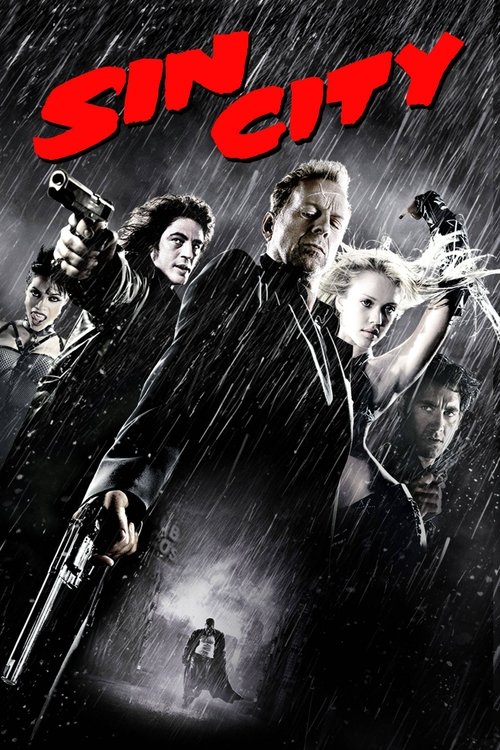
Sin City (2005) is a superhero film adapted from Dark Horse Comics, directed by Frank Miller, Robert Rodriguez, Quentin Tarantino and starring Bruce Willis and Mickey Rourke. The film is part of the Dark Horse and was released by Dimension Films. Runtime: 2h 4m. Rated R. Audience rating: 8.0/10.
What is Sin City (2005) about?
Three interlocking tales of crime and violence in Basin City: a cop protecting a young girl, a brute seeking revenge for a love's murder, and a killer protecting a district of prostitutes.
Released in 2005, Sin City was directed by Frank Miller, Robert Rodriguez, Quentin Tarantino and produced under the Dimension Films banner. The film occupies a significant place within the Dark Horse — contributing to the ongoing narrative and mythology of that cinematic universe.
The film features lead performances from Bruce Willis, Mickey Rourke, Clive Owen, among others, anchoring a story that adapts characters first brought to life in Dark Horse Comics. Its source material gives the film a foundation rooted in decades of published storytelling, which Tarantino and the creative team interpret through a cinematic lens.
With an audience rating of 8.0, Sin City is generally praised as a strong entry in the superhero genre — its strengths in storytelling, performance, and production design regularly cited by viewers.
What happens in Sin City (2005)? — Full Plot
Sin City is an anthology film. Three Frank Miller stories from his Sin City comic series — adapted directly by Miller alongside Robert Rodriguez (and a single sequence directed by Quentin Tarantino as guest director) — unfold across the same noir-stylized fictional city of Basin City, nicknamed 'Sin City' by its inhabitants. The film uses a stark monochromatic black-and-white visual aesthetic with selective color highlighting (yellow for the Yellow Bastard's skin, red for blood and lipstick, blue for one specific character's eyes). The visual approach was achieved through extensive green-screen photography and digital post-production color-grading. The entire film was shot on a single Austin, Texas soundstage using virtually no practical sets. The shooting style was the first major studio attempt to fully adapt a comic book panel-by-panel onto screen.
The film opens with a wraparound prologue / epilogue — 'The Customer Is Always Right' — directed by Frank Miller and Robert Rodriguez. A nameless suited Salesman (Josh Hartnett, in voice-over and brief appearance) encounters a wealthy woman in a red dress on a Basin City rooftop. The two share a brief intimate moment. He shoots her with a silenced pistol. The opening establishes the film's visual signature: deeply-noir cinematography, French New Wave dialogue rhythm, and morally-compromised protagonist as audience-surrogate. The wraparound returns at the film's conclusion.
The first story: 'That Yellow Bastard.' Detective John Hartigan (Bruce Willis, in a career-revivifying performance) is hours from retirement when he investigates the kidnapping of 11-year-old Nancy Callahan. The kidnapper is Roark Junior — son of corrupt Senator Patrick Henry Roark (Powers Boothe), the most-powerful political figure in Basin City. Roark Junior is a serial pedophile-murderer being shielded by his father's political influence. Hartigan locates Roark Junior at an abandoned harbor. He shoots him in the genitals, severing Roark Junior's reproductive organs. Hartigan is shot by his own partner (Roark-aligned) during the rescue and falls into a coma.
Hartigan wakes 8 years later, framed by Senator Roark for the original Nancy-kidnapping case. He has been falsely-convicted and imprisoned. He has been receiving anonymous letters from someone claiming to be Nancy — now 19 and grown. He is released after serving his sentence. He tracks Nancy (Jessica Alba) to her current career as a Sin City strip-club dancer. The two reunite. Roark Junior, now nicknamed the Yellow Bastard (Nick Stahl, in heavy yellow prosthetic makeup) due to a botched genetic-restoration procedure his father funded, has been hunting Nancy for 8 years to complete his original revenge. Hartigan rescues Nancy and shoots himself to ensure Roark Junior cannot use him to find her — a tragically-noir ending.
The second story: 'The Hard Goodbye.' Marv (Mickey Rourke, in heavy facial prosthetics that transformed him into the canonical comics-Marv visual) is a hulking, scarred ex-con with a heart of gold. He wakes up next to the corpse of Goldie — the only woman who has ever shown him sexual kindness — in a Sin City hotel room. He has been framed for her murder. Marv embarks on a methodical revenge mission across Sin City, tracking Goldie's killer with brutal physical-investigation methods. He encounters Goldie's twin sister Wendy, a vigilante prostitute who initially tries to kill him for the framing.
Marv discovers Goldie's killer: Kevin (Elijah Wood, in a silent performance), a cannibalistic priest's-nephew who has been kidnapping prostitutes and consuming them at his father Cardinal Roark's Sin City estate. Marv kills Kevin in a brutal hand-to-hand sequence — feeding Kevin's dismembered body to wolves. He then confronts Cardinal Roark himself, the cardinal-uncle of Senator Roark, who has been covering up Kevin's crimes for decades. Marv kills Cardinal Roark. He is captured by Sin City police and executed by electric chair. The story is the most-violent of the three narratives and the most-emotionally-devastating; Marv's monologue in his final moments has been widely cited as the film's most-iconic single sequence.
The third story: 'The Big Fat Kill.' Dwight McCarthy (Clive Owen, in dark hair from his canonical original-coloring blond visual) is a former war photographer in self-imposed exile. His ex-girlfriend Gail (Rosario Dawson) leads the Old Town district's prostitute-collective. The district has been operating as a self-governing area through a long-standing truce with the Sin City police — the prostitutes police themselves and the cops stay out. Dwight encounters Jackie Boy (Benicio del Toro), an off-duty corrupt cop who has been brutalizing the Old Town prostitutes. Jackie attacks Becky (Alexis Bledel), a young prostitute Dwight has been protecting.
Dwight kills Jackie. The body is dumped in an alley. The Sin City police discover the body and recognize their fellow cop. The truce is breaking; the police are preparing to invade Old Town and dismantle the prostitute-collective. Dwight and the Old Town girls plan a coordinated counter-attack. The third-act battle features Dwight, Gail, Miho (the silent samurai prostitute played by Devon Aoki), and the rest of the Old Town defense force ambushing the corrupt cop-team in an Old Town alley. The Sin City corruption-conspiracy is briefly exposed. The truce is preserved through the deaths of the corrupt cop-team. The story is the most action-heavy of the three and provides the film's most-elaborate combat choreography.
The three stories interlock thematically — power, corruption, masculine grief, the price of vigilante justice. Each story features Frank Miller's signature stylistic elements: monochromatic noir cinematography, anti-heroic male protagonists who use violence as moral compensation, female characters who are either victims or vengeance-driven warriors, deeply-stylized hard-boiled dialogue. The dialogue is structured as inner-monologue voice-over — each protagonist narrates his own story in present-tense. The voice-over style was Miller's specific creative choice, drawn from the 1940s-50s American hard-boiled detective fiction tradition (Raymond Chandler, Dashiell Hammett).
The cast included multiple major actors playing relatively-brief roles. Bruce Willis (Hartigan), Mickey Rourke (Marv), Clive Owen (Dwight) carry the three main storylines. Supporting cast included Jessica Alba (Nancy), Elijah Wood (Kevin), Rosario Dawson (Gail), Brittany Murphy (Shellie), Michael Madsen (Bob), Powers Boothe (Senator Roark), and Nick Stahl (Yellow Bastard). The cast also featured Tarantino's directed-by-guest sequence: a brief scene where Dwight has a hallucinatory conversation with the recently-dead Jackie Boy while driving Jackie's corpse through Sin City streets. The Tarantino sequence is widely considered one of the film's most-memorable single moments.
The film's epilogue. The opening Salesman-and-red-dressed-woman wraparound returns at the film's conclusion; the Salesman is revealed to have been operating as a contract killer the entire film. He encounters a new client — Becky (Alexis Bledel from the third story) — who has been betraying the Old Town truce by selling information to the corrupt-cop conspiracy. The Salesman shoots her. The film closes with the cast and crew taking individual curtain calls in monochrome black-and-white silhouette. Each character moves in slow-motion before the final fade-out.
Commercial and critical aftermath. Sin City grossed $158 million worldwide on a $40 million production budget — strong commercial success. Critics widely praised the film's visual ambition, the panel-by-panel comic-faithful adaptation approach, and the cast's commitment to the noir-styled performances (Rotten Tomatoes 78%). The film established the green-screen graphic-novel adaptation as a viable genre — paving the way for 300 (2007) by Zack Snyder, the visual approach of Watchmen (2009), and multiple subsequent graphic-novel adaptations. Robert Rodriguez and Frank Miller collaborated again on Sin City: A Dame to Kill For (2014), which was a significant commercial disappointment.
Who stars in Sin City (2005)?
Find Sin City (2005) on Amazon
Watch Sin City on Prime Video, browse the original Dark Horse Comics source material, and discover Blu-rays, soundtracks, and related merchandise on Amazon.
As an Amazon Associate, I earn from qualifying purchases. Link clicks do not affect editorial coverage — see our disclaimer.
What are some facts about Sin City (2005)?
Sin City released in 2005, placing it within the 2000s era of comic book cinema — a decade that marked the modern superhero cinema revolution.
Directed by Frank Miller, Robert Rodriguez, Quentin Tarantino, the film was produced by Dimension Films and adapts source material from Dark Horse Comics.
The principal cast features Bruce Willis and Mickey Rourke, with key supporting roles played by Clive Owen, Benicio del Toro, Elijah Wood.
The film belongs to Dark Horse — a distinct corner of comic book cinema.
Sin City carries an audience rating of 8.0 — a strong critical benchmark that few comic book films have achieved.
The Dark Horse Comics source material for Sin City has been in continuous publication for decades, giving filmmakers a rich well of storylines, character arcs, and iconography to draw upon.
Films from this era combined practical stunts with the rising CGI industry — many sequences would be impossible with either technology alone.
Sin City is catalogued on Movies on Comics among our collection of 164 comic book films spanning 48 years of cinema — from Richard Donner's 1978 Superman to the present day.
Easter Eggs & Hidden Details in Sin City (2005)
Frank Miller's panel-by-panel cinematic translation. The deep cuts include Rodriguez quitting the DGA and Quentin Tarantino directing a single sequence.
Robert Rodriguez was contractually obligated to direct Sin City alone under his Director's Guild membership. Rodriguez wanted Frank Miller — the comic's original author — to receive co-director credit. The DGA refused. Rodriguez quit the DGA in protest. The film was credited to both Rodriguez and Miller.
Quentin Tarantino directed a single sequence — featuring Benicio del Toro as Jackie Boy — for one dollar in exchange for the experience. Tarantino reportedly considered Sin City the most-difficult production challenge of his career.
Mickey Rourke's Marv — a hulking, scar-faced anti-hero — became the role that revived Rourke's career after years of decline. Rourke was 53 when he played Marv. His performance was widely cited as the film's standout, earning a Best Supporting Actor Golden Globe nomination.
The film's visual style — monochromatic noir cinematography, hyper-violent action, deliberate single-tone color (red blood, yellow eyes) — was a deliberate panel-by-panel translation of Miller's comic art. Every shot was reverse-engineered from Miller's source material.
Jessica Alba's Nancy Callahan — Bruce Willis's adopted daughter character — was widely cited as the film's most-restrained character. Alba's commitment to playing Nancy with deliberate emotional vulnerability rather than action-hero confidence was widely praised.
Bruce Willis's Detective John Hartigan — the film's most-emotionally-anchored character — was widely cited as the franchise's most-tragic character. Hartigan's suicide to protect Nancy from Junior was the film's emotional centerpiece.
Sin City established the green-screen graphic-novel adaptation as a viable genre — paving the way for 300 (2007) by Zack Snyder and the visual approach of Watchmen (2009).
Sin City grossed $158 million globally on a $40 million budget — strong commercial success. Critics praised the visual fidelity but were divided on the film's politics — particularly Miller's gendered violence against women.
Brittany Murphy — playing the waitress Shellie — died in late 2009. Her performance in Sin City was widely cited as a memorable but minor role in her career.
Marv's Hard Goodbye sequence — tracking down his murdered lover Goldie's killer — was widely cited as the franchise's most-effective single-character arc. The sequence's brutal climax (with Elijah Wood's silent cannibal Kevin) was widely covered as the film's most-disturbing moment.


💬 Reader Comments