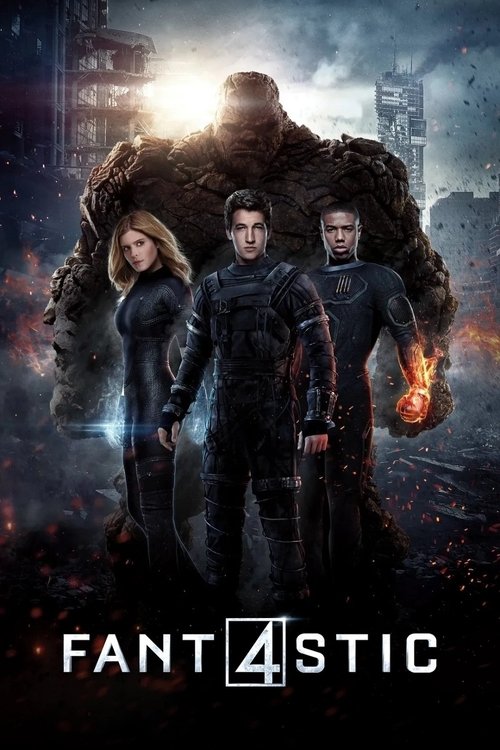
Fantastic Four (2015) is a superhero film adapted from Marvel Comics, directed by Josh Trank and starring Miles Teller and Michael B. Jordan. The film is a standalone production outside any shared cinematic universe and was released by 20th Century Fox. Audience rating: 4.3/10.
What is Fantastic Four (2015) about?
Four young scientists teleport to an alternate dimension and are exposed to an energy that fundamentally transforms each of them in unexpected ways, forcing them to work together against a new threat.
Released in 2015, Fantastic Four was directed by Josh Trank and produced under the 20th Century Fox banner. The film occupies a significant place within the Independent — telling a self-contained story outside of shared-continuity superhero franchises.
The film features lead performances from Miles Teller, Michael B. Jordan, Kate Mara, among others, anchoring a story that adapts characters first brought to life in Marvel Comics. Its source material gives the film a foundation rooted in decades of published storytelling, which Trank and the creative team interpret through a cinematic lens.
The film's 4.3 audience rating indicates a mixed response. Even so, it holds interest as part of the broader Independent catalogue and for how it fits into the lineage of Marvel Comics-based cinema.
What happens in Fantastic Four (2015)? — Full Plot
We open with young Reed Richards as a child experimenting with interdimensional travel. He is approximately 11 years old, working in his suburban-American garage on a homemade device that he believes will transport small objects to a parallel dimension. His teacher, Mr. Kenny, dismisses his ambitions as child-pseudoscience. His parents Mr. And Mrs. Richards support his experimentation despite their modest-financial-circumstances. The opening 8 minutes establish Reed as prodigy-isolated-from-mainstream-academic-institutions.
Reed has a single childhood best friend: Ben Grimm, the son of the Grimm family who operate a small auto-repair business across the street from Reed's family home. The two boys form a foundational friendship across American-childhood years. Ben is tough-physically — he has been bullied by his older-brother but has emotional-resilience. Ben supports Reed's scientific-ambitions even when their peer-group canonically-mocks him. Reed and Ben spend childhood-years working together on the interdimensional-transport device.
Cut to: present day (2015). Reed Richards (Miles Teller) is now a college-bound prodigy at Baxter Foundation — a research-institution recruiting young minds for interdimensional-research projects. Baxter is run by Dr. Franklin Storm (Reg E. Cathey) — a charismatic-Black-American scientist whose research-funding comes from government-defense-and-corporate-sources. Storm has two children: his adopted-daughter Sue Storm (Kate Mara) and his biological-son Johnny Storm (Michael B. Jordan). The Baxter Foundation has been quietly-developing interdimensional-transport-technology for over a decade.
Reed, working with the Storm siblings and a new recruit Victor Von Doom (Toby Kebbell), develops a working interdimensional-transport device. The device is called the Quantum Gate — a large-scale platform that can transport human passengers to a parallel-dimension called Planet Zero. The team's research is funded by U.S. Military forces who intend to weaponize the technology. Reed is uncomfortable with the military-application but accepts the funding to continue the research. Victor Von Doom is skeptical of the team and has been quietly-developing his own parallel-research stream.
The team conducts their first manned trip to Planet Zero. Reed, Victor, Ben Grimm, and Johnny Storm volunteer for the trip without informing Sue (who would have prevented the unauthorized-experiment). The Quantum Gate successfully canonically-transports them to Planet Zero — a barren-rocky parallel-dimension landscape with distinctive-green-energy-radiation throughout the atmosphere. The team explores the planet for approximately one hour. Victor is fascinated by the green-energy and attempts to canonically-extract a sample.
The team's exploration is disturbed by a cosmic-energy-event. Victor falls into a pool of liquid green energy. The remaining team — Reed, Ben, Johnny — attempt to canonically-rescue him but cannot. The Quantum Gate's instability-warnings activate; the team must evacuate immediately. Sue, having been alerted to the unauthorized trip, attempts to extract them via the Gate. The evacuation is rushed and chaotic. Sue, Reed, Ben, and Johnny are transported back to Earth. Victor is left behind in the energy-pool.
The evacuated-team-of-four is affected by the Planet-Zero-cosmic-energy. The cosmic-energy-exposure has been amplified by the Quantum-Gate-disruption during the evacuation. The four experience immediate transformation upon returning to Earth: Reed has elastic-stretching abilities; Sue has invisibility-and-force-field generation; Johnny has pyrokinetic abilities; Ben has been transformed into the rock-skinned monstrosity. The transformation-sequence is approximately 10 minutes of screen-time depicting the team's immediate-physical-changes.
One year later, the team has been integrated into a government black-ops research program. The team has been confined to a classified U.S. Military research facility for the twelve-month period. Their abilities have been systematically-studied by government scientists. Victor is presumed dead — no recovery from the Planet Zero energy-pool has been conducted. The government wants to weaponize the team's abilities for military-applications. Reed has been resisting the weaponization but has been largely-powerless to stop it.
Victor returns from the parallel-dimension. He has been alive in the Planet-Zero-energy-pool for the twelve-month period — the green-energy has been sustaining and amplifying his cellular-structure. He emerges from a second-Quantum-Gate-event transformed into Doctor Doom — a reality-bending entity with substantially-superior-power-levels compared to the Fantastic-Four. Doom has been fundamentally-changed by his Planet-Zero-experience: he believes humanity must be destroyed to prevent the Quantum-Gate-technology from spreading.
The team confronts Doctor Doom in the Planet-Zero parallel-dimension. The final battle is substantially-CGI-driven; the four Fantastic-Four-members engage Doom's reality-bending-attacks across the barren-landscape of Planet Zero. The combat-choreography is CGI-heavy and was widely criticized at release for its visual-incoherence. The team defeats Doom through coordinated combat — using their individual-abilities in a team-formation that mirrors the 2005-Fantastic-Four-team-formation. Doom is defeated in the final-cosmic-energy-confrontation.
The film's epilogue. The team is restored to public-life. They formally-announce themselves as the Fantastic-Four at a Manhattan-press-conference. The press-conference sequence is deliberately-restrained — the team appears emotionally-exhausted rather than celebratory. The conclusion is deliberately-anticlimactic; the original-screenplay-ending was substantially-different and restored only through post-production-reshoots. The film's original-creative-vision was substantially-changed by the studio-mandated reshoots.
Commercial and critical reception. Fantastic Four (2015) grossed $168 million worldwide on a $120 million production budget — a critical and commercial disaster. Critics widely-panned the film (Rotten Tomatoes 9% — one of the lowest scores ever received by a major-studio superhero film). Director Josh Trank publicly-disowned the film via Twitter the day before theatrical-release. The 2015 Fantastic Four became a foundational example of troubled-studio-productions; multiple industry-publications have studied the production-history as cautionary-tale. Fox's Fantastic-Four franchise was effectively-retired after the 2015 release; the Fantastic-Four-rights reverted to Marvel Studios through the Disney-Fox acquisition (2019). Marvel Studios rebooted the franchise with Fantastic Four: First Steps (2025) starring Pedro Pascal.
Who stars in Fantastic Four (2015)?
Find Fantastic Four (2015) on Amazon
Watch Fantastic Four on Prime Video, browse the original Marvel Comics source material, and discover Blu-rays, soundtracks, and related merchandise on Amazon.
As an Amazon Associate, I earn from qualifying purchases. Link clicks do not affect editorial coverage — see our disclaimer.
What are some facts about Fantastic Four (2015)?
Fantastic Four released in 2015, placing it within the 2010s era of comic book cinema — a decade that saw superhero films become the dominant force at the global box office.
Directed by Josh Trank, the film was produced by 20th Century Fox and adapts source material from Marvel Comics.
The principal cast features Miles Teller and Michael B. Jordan, with key supporting roles played by Kate Mara, Jamie Bell, Toby Kebbell.
The film belongs to Independent — an independent / standalone production, not tied to a shared cinematic universe.
Fantastic Four carries an audience rating of 4.3 — a mixed reception that highlights the divisive nature of superhero film adaptations.
The Marvel Comics source material for Fantastic Four has been in continuous publication for decades, giving filmmakers a rich well of storylines, character arcs, and iconography to draw upon.
Modern superhero films like this one use a mix of practical effects and digital VFX, with entire sequences often shot against volume walls or LED stages pioneered by shows like The Mandalorian.
Fantastic Four is catalogued on Movies on Comics among our collection of 164 comic book films spanning 48 years of cinema — from Richard Donner's 1978 Superman to the present day.
💬 Reader Comments