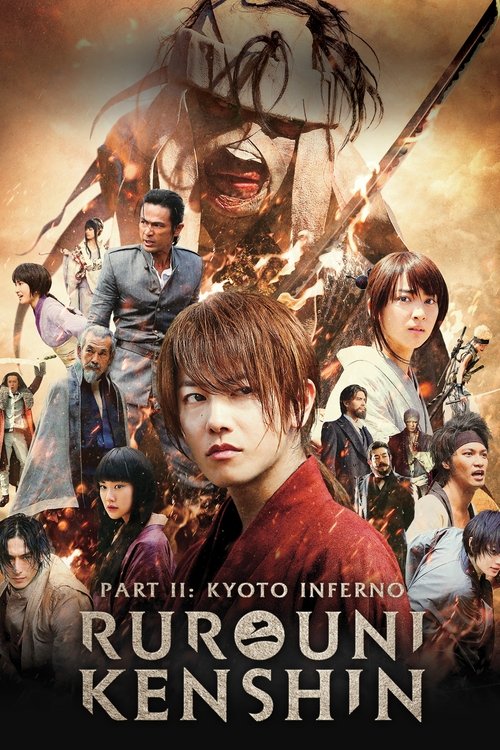
Rurouni Kenshin: Kyoto Inferno (2014) is a Japanese-language superhero film adapted from Manga, directed by Keishi Otomo and starring Takeru Satoh and Emi Takei. The film is a standalone production outside any shared cinematic universe and was released by Warner Bros. Japan. Audience rating: 7.7/10.
What is Rurouni Kenshin: Kyoto Inferno (2014) about?
Kenshin is called upon to stop the most fearsome swordsman of the revolution era — Makoto Shishio — who plans to overthrow the new Meiji government through ruthless destruction.
Released in 2014, Rurouni Kenshin: Kyoto Inferno was directed by Keishi Otomo and produced under the Warner Bros. Japan banner. The film occupies a significant place within the Independent — telling a self-contained story outside of shared-continuity superhero franchises.
The film features lead performances from Takeru Satoh, Emi Takei, Ryunosuke Kamiki, among others, anchoring a story that adapts characters first brought to life in Manga. Its source material gives the film a foundation rooted in decades of published storytelling, which Otomo and the creative team interpret through a cinematic lens.
With an audience rating of 7.7, Rurouni Kenshin: Kyoto Inferno is generally praised as a strong entry in the superhero genre — its strengths in storytelling, performance, and production design regularly cited by viewers.
What happens in Rurouni Kenshin: Kyoto Inferno (2014)? — Full Plot
Three years after the events of Rurouni Kenshin (2012), Kenshin Himura (Takeru Satoh) continues his peaceful wandering life with Kaoru in Tokyo. The Japanese government has been investigating a major threat in Kyoto — Makoto Shishio, who replaced Kenshin as the government's primary assassin during the Bakumatsu civil war, has been planning to overthrow the Meiji government and establish a new authoritarian regime.
Government official Toshimichi Okubo (Junpei Mizobata) approaches Kenshin in Tokyo, requesting his help in dealing with Shishio. Kenshin initially refuses — his no-kill vow makes him reluctant to engage with another former assassin. Shortly after their meeting, Okubo is assassinated by Shishio's primary lieutenant Sojiro Seta (Ryunosuke Kamiki). Kenshin reluctantly agrees to travel to Kyoto.
Kenshin's journey to Kyoto is solitary. He leaves Kaoru and his other Tokyo allies behind. En route, he encounters Misao Makimachi (Tao Tsuchiya), a young ninja from the Oniwabanshu intelligence organisization. Misao recognisizs Kenshin and joins him; her organisization has been monitoring Shishio's activities and provides Kenshin with intelligence about his operations.
Shishio has assembled the Juppongatana — ten of Japan's most skilled swordsmen, each with their own combat speciality. The roster includes Sojiro Seta, Aoshi Shinomori (Yusuke Iseya, the Oniwabanshu's former leader), Anji the giant monk, and other dangerous fighters. Shishio's plan is to use the Juppongatana to systematically eliminate the Meiji government's senior officials, then march on Tokyo with his private army.
Kenshin's first major confrontation in Kyoto is against Sojiro Seta. Their duel is the franchise's most cinematically composed combat sequence; Sojiro's speed and emotionless approach test Kenshin's commitment to his no-kill vow. The duel ends inconclusively — neither swordsman can definitively defeat the other. Sojiro retreats with a vow to return; Kenshin's sakabato is also broken during the fight.
The middle act follows Kenshin's search for sword-smith Seiku Arai (Min Tanaka), whose ancestral family forged the original sakabato. Arai initially refuses to forge a new sword — his family swore off swordmaking after the Meiji Restoration. Kenshin's appeal to Arai's pacifist principles eventually convinces him; Arai forges a new sakabato, which Kenshin will use in the franchise's subsequent battles.
Shishio's plan begins escalating into action. He launches the Rengoku — an ironclad warship — toward Tokyo, intending to bombard the city while his Juppongatana attack from land. Kenshin and his allies (including the police-officer Saito Hajime, played by Yosuke Eguchi) race to intercept the Rengoku before it reaches Tokyo. The film ends on a cliffhanger as Kenshin prepares for his next confrontation with Shishio.
Who stars in Rurouni Kenshin: Kyoto Inferno (2014)?
Find Rurouni Kenshin: Kyoto Inferno (2014) on Amazon
Watch Rurouni Kenshin: Kyoto Inferno on Prime Video, browse the original Manga source material, and discover Blu-rays, soundtracks, and related merchandise on Amazon.
As an Amazon Associate, I earn from qualifying purchases. Link clicks do not affect editorial coverage — see our disclaimer.
What are some facts about Rurouni Kenshin: Kyoto Inferno (2014)?
Rurouni Kenshin: Kyoto Inferno released in 2014, placing it within the 2010s era of comic book cinema — a decade that saw superhero films become the dominant force at the global box office.
Directed by Keishi Otomo, the film was produced by Warner Bros. Japan and adapts source material from Manga.
The principal cast features Takeru Satoh and Emi Takei, with key supporting roles played by Ryunosuke Kamiki, Tatsuya Fujiwara.
The film belongs to Independent — an independent / standalone production, not tied to a shared cinematic universe.
Rurouni Kenshin: Kyoto Inferno carries an audience rating of 7.7 — putting it in the solid-to-excellent tier of the genre.
The Manga source material for Rurouni Kenshin: Kyoto Inferno has been in continuous publication for decades, giving filmmakers a rich well of storylines, character arcs, and iconography to draw upon.
Modern superhero films like this one use a mix of practical effects and digital VFX, with entire sequences often shot against volume walls or LED stages pioneered by shows like The Mandalorian.
Rurouni Kenshin: Kyoto Inferno is catalogued on Movies on Comics among our collection of 164 comic book films spanning 48 years of cinema — from Richard Donner's 1978 Superman to the present day.
💬 Reader Comments