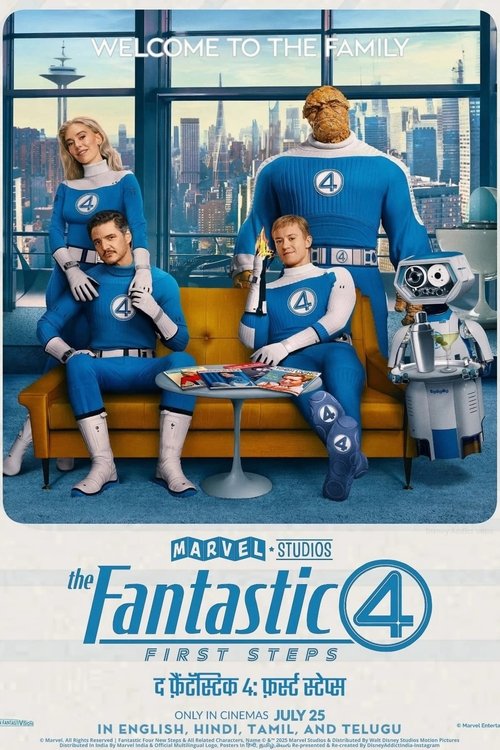
The Fantastic Four: First Steps (2025) is a superhero film adapted from Marvel Comics, directed by Matt Shakman and starring Pedro Pascal and Vanessa Kirby. The film is part of the MCU and was released by Marvel Studios. Runtime: 2h 10m. Rated PG-13. Audience rating: 7.6/10.
What is The Fantastic Four: First Steps (2025) about?
Marvel's First Family — Reed Richards, Sue Storm, Johnny Storm, and Ben Grimm — face the world-devouring cosmic entity Galactus in a retro-futuristic alternate universe, forced to make an impossible sacrifice to save their world.
Released in 2025, The Fantastic Four: First Steps was directed by Matt Shakman and produced under the Marvel Studios banner. The film occupies a significant place within the MCU — contributing to the ongoing narrative and mythology of that cinematic universe.
The film features lead performances from Pedro Pascal, Vanessa Kirby, Joseph Quinn, among others, anchoring a story that adapts characters first brought to life in Marvel Comics. Its source material gives the film a foundation rooted in decades of published storytelling, which Shakman and the creative team interpret through a cinematic lens.
With an audience rating of 7.6, The Fantastic Four: First Steps is generally praised as a strong entry in the superhero genre — its strengths in storytelling, performance, and production design regularly cited by viewers.
What happens in The Fantastic Four: First Steps (2025)? — Full Plot
On an alternate Earth (designated Earth-828 in the wider MCU multiverse), the Future Foundation — Reed Richards (Pedro Pascal), Sue Storm (Vanessa Kirby), Johnny Storm (Joseph Quinn) and Ben Grimm (Ebon Moss-Bachrach) — are four years removed from the space accident that gave them their powers. The film opens with archival footage: black-and-white news reels of the four returning from cosmic radiation exposure aboard the Excelsior-1 probe, a Life Magazine cover declaring them 'The First Family of the Atomic Age,' television specials, talk-show appearances, and a Saturday-morning cartoon based on their exploits. This is Marvel's first sustained attempt to depict superheroes as full popular celebrities — they have a fan club, a merchandising deal, a children's book series, and a Mayoral key to New York.
The film's design language is mid-century retrofuture. Earth-828 looks like the cover of a 1962 issue of Popular Mechanics: monorails over Manhattan, atomic-powered domestic appliances, a Mars expedition that has already happened, vacuum-tube computers the size of small rooms. The Future Foundation themselves operate from the Baxter Building, a Frank Lloyd Wright-adjacent skyscraper with a publicly accessible exhibit floor where school children come on field trips to gawk at H.E.R.B.I.E., Reed's helper robot. Shakman has openly said that this is Marvel's attempt at a Mad Men-era family drama where the family also has a flying car.
Reed and Sue are, in the film's opening private moments, expecting their first child. The pregnancy is a closely-guarded family secret because the cosmic radiation that gave them powers also makes the medical risk profile completely unknown. Reed has spent months running quiet tests on his own DNA and Sue's, trying to predict whether the baby will be human, mutated, or something neither of them can survive delivering. The scene where Sue tells Johnny and Ben — over breakfast, in their kitchen pyjamas — is the film's first genuine laugh and its first emotional anchor: Ben is so happy he cries; Johnny immediately asks if he gets to name the baby; Sue gently refuses.
The crisis begins when the Silver Surfer (Julia Garner, in motion-capture and uncanny digital make-up) arrives on Earth. She lands her board on the steps of the Baxter Building, addresses Mr. Richards by his Kryptonian — sorry, cosmic — full title, and announces that her master Galactus is coming in twenty-eight days to consume the planet. Earth has been chosen. Earth has thirty days. The Surfer leaves the Future Foundation a pulsing cosmic beacon as a sign of good faith and lifts off again, leaving the world's most photographed family with an unannounced apocalypse and an unborn baby.
What follows is a structured, almost procedural countdown. Reed and Sue first try diplomacy: they take the cosmic beacon, build a stardrive, and fly the Excelsior-2 out to confront Galactus directly. They find him in a region of dead space orbiting a star system he has already consumed — a man-shaped void roughly the size of Saturn, helmeted and armored, surrounded by the radiation echo of millions of dead worlds. Reed pleads. Galactus listens. Galactus offers an exchange: he will spare Earth — permanently, treaty-bound — if the Richardses turn over the baby. He has sensed the unborn child's potential, calls it 'the spark of cosmic awareness,' and explains, almost gently, that a child of Reed and Sue's bloodline contains exactly the energy he requires to survive without consuming further worlds. One child, one trade, one billion lives spared per year. Reed and Sue refuse and flee.
Earth's reaction to the news of Galactus is the film's most emotionally complex sequence. Initially the Foundation is treated as heroic for refusing the bargain; then, as the countdown clock drops below ten days, public opinion polarisizs. A faction of the public, organisizd by the firebrand Senator Jasper Sitwell (a brief Mark Ruffalo cameo, in a sly multiversal joke), argues openly that the Richardses are murdering eight billion people to save one child. Protesters surround the Baxter Building. The President asks the Foundation to surrender the baby. Ben — gruff, decent, the moral compass of every Fantastic Four story since 1961 — punches a man for spitting at Sue in a parking garage and is briefly arrested.
Inside this firestorm, Sue goes into labor two weeks early. The delivery happens in the Baxter Building's sub-basement medical bay, with Reed mid-experiment and Johnny holding her hand. Sue's invisible-force-field powers manifest defensively during the birth — at one point the entire delivery room is shielded inside a force-field big enough to keep out the news helicopters that have been hovering overhead for a week. The baby — a boy — is named Franklin Richards. He is, by every measurement Reed can take, the most powerful sentient being ever born on Earth. Reed cannot finish a single sensor reading before Franklin's mere presence shorts the instrument.
The Silver Surfer's arc, parallel to the family's, is the film's quietest pleasure. Garner's Surfer is initially adamant in her loyalty to Galactus, but the Foundation's repeated kindness — Johnny in particular spends an awkward, charming chunk of the film befriending her — slowly cracks the cosmic indoctrination. The Surfer reveals that she was once a being named Shalla-Bal, that her own homeworld was about to be consumed, and that she became Galactus's herald specifically to spare her world by hunting other worlds in its place. She has been a herald for thousands of years. She has hated every day of it. By the time Galactus's ships arrive in Earth orbit, the Surfer has covertly given the Foundation a single, devastating piece of intel: Galactus is functionally an addict, and the cosmic radiation he eats is not the only energy that sustains him. His armor, his helmet, his entire form is held together by the force he extracts from worlds. Cut off that intake and he becomes vulnerable.
The plan is engineered in the film's last forty minutes with the procedural detail of a heist film. Reed builds a teleportation gate inspired by the Surfer's cosmic awareness, capable of repurposing Galactus's own consumption energy. Sue's powers are weaponised at a scale she has never attempted: she becomes the focal lens through which the teleport happens. Ben covers them on the ground in Manhattan against falling debris. Johnny — and this is the moment that breaks the audience — burns brighter than he has in any previous appearance, flying directly into Galactus's helmet to overload the energy intake from the inside. The gate opens, and the Foundation collectively wrenches Galactus halfway through it to a region of the void where his energy intake cannot reach. Mid-translation, Sue's powers fail; Reed extends himself like a rubber band across the entire eastern seaboard to hold the gate open; Johnny detonates inside Galactus's helmet; the Surfer, suddenly free of her master's psychic grip, dives in to finish the job. Galactus disappears, halfway through eating the planet, halfway through nowhere.
The cost is enormous. Johnny is gone — vanished into Galactus's helmet with his Human Torch flame burning at temperatures that should have evaporated his body, and no one can confirm whether he is dead or trapped somewhere in deep space. Reed's stretching has done something permanent to his nervous system; he can still extend, but it now causes him real pain. The Silver Surfer, freed from Galactus, is adopted as a fifth member of the family — Quinn's absence creating a sister-shaped hole that Garner steps cautiously into. Franklin is alive, healthy, and the most-watched newborn in human history.
The film closes with a tight, domestic epilogue. The Foundation appears on the same television talk show that opened the film, this time as a family of four — Reed, Sue, Ben, Shalla-Bal — with baby Franklin on Sue's lap. Reed is asked, almost in passing, whether he believes Johnny is dead. Reed says no. He says it with the certainty of a man who has been engineering doors for years. The mid-credits scene cuts to a featureless white void: Johnny Storm, alive, scorched, kneeling on the floor of an unfamiliar throne room, looking up at a man in green armor and an iron mask whose voice — for the first time on film, in a single line — confirms what the audience has known since the post-credits of Brave New World: Victor von Doom (Robert Downey Jr.) has him. Avengers: Doomsday begins where First Steps ends.
Who stars in The Fantastic Four: First Steps (2025)?
Find The Fantastic Four: First Steps (2025) on Amazon
Watch The Fantastic Four: First Steps on Prime Video, browse the original Marvel Comics source material, and discover Blu-rays, soundtracks, and related merchandise on Amazon.
As an Amazon Associate, I earn from qualifying purchases. Link clicks do not affect editorial coverage — see our disclaimer.
What are some facts about The Fantastic Four: First Steps (2025)?
The Fantastic Four: First Steps released in 2025, placing it within the 2020s era of comic book cinema — a decade that saw superhero films become the dominant force at the global box office.
Directed by Matt Shakman, the film was produced by Marvel Studios and adapts source material from Marvel Comics.
The principal cast features Pedro Pascal and Vanessa Kirby, with key supporting roles played by Joseph Quinn, Ebon Moss-Bachrach, Julia Garner, Ralph Ineson.
The film belongs to MCU — the Marvel Cinematic Universe — the highest-grossing film franchise of all time.
The Fantastic Four: First Steps carries an audience rating of 7.6 — putting it in the solid-to-excellent tier of the genre.
The Marvel Comics source material for The Fantastic Four: First Steps has been in continuous publication for decades, giving filmmakers a rich well of storylines, character arcs, and iconography to draw upon.
Modern superhero films like this one use a mix of practical effects and digital VFX, with entire sequences often shot against volume walls or LED stages pioneered by shows like The Mandalorian.
The Fantastic Four: First Steps is catalogued on Movies on Comics among our collection of 164 comic book films spanning 48 years of cinema — from Richard Donner's 1978 Superman to the present day.
Easter Eggs & Hidden Details in The Fantastic Four: First Steps (2025)
Matt Shakman's retro-futuristic First Steps is the densest Marvel film for visual references since Doctor Strange in the Multiverse of Madness. Almost every set, every prop, and every cameo references either Kirby's original 1961-1969 Fantastic Four run or Marvel's wider multiverse setup.
The film's alternate Earth is officially designated Earth-828 in dialogue. The number references August 28th, 1922 — Jack Kirby's birthday. Marvel has formally adopted this designation in tie-in comics and the wider MCU multiverse, making the Earth a permanent tribute to the FF's co-creator.
Reed Richards's helper robot H.E.R.B.I.E. (Humanoid Experimental Robot B-Type Integrated Electronics) is voiced by Matthew Wood — the long-time Lucasfilm sound editor who has voiced Battle Droids and General Grievous in Star Wars. The casting is a quiet acknowledgement of H.E.R.B.I.E.'s history as the Saturday-morning cartoon FF replacement for Johnny Storm in the late 1970s, when network censors disallowed depicting a teenage boy on fire.
The Future Foundation's first cosmic probe — the one that gives them their powers — is called the Excelsior-1. The name is a tribute to Stan Lee, whose signature sign-off across his Marvel columns and conventions was 'Excelsior!'
Julia Garner's Silver Surfer is named Shalla-Bal — in the comics, Norrin Radd's lost love from his home planet Zenn-La. Shakman's decision to genderswap the role (and combine the two characters into one figure) was controversial pre-release; in the final cut, Shalla-Bal's arc explicitly mirrors the original Norrin Radd story while adding the romantic loss that the comics had previously kept separate.
Ralph Ineson — best known for The Witch (2015) and as Amycus Carrow in Harry Potter — voices Galactus. His casting was kept secret until release, with Marvel marketing referring to Galactus only as 'a cosmic figure.' Ineson's voice is processed through subsonic frequency layering that makes IMAX seats physically vibrate during his dialogue.
In an early scene, Reed is shown working on a piece of equipment labelled 'N-Zone Portal Prototype'. The Negative Zone is, in the comics, an alternate-dimension realm ruled by the villain Annihilus and a major Fantastic Four storyline. The portal does not activate in this film but is a clear setup for a future sequel.
In a single shot during the second act, a small, hat-wearing figure is briefly visible in a New York subway station — instantly recognisable to FF readers as Harvey Rupert Elder / The Mole Man. The Mole Man was the very first villain the Fantastic Four ever fought, in Fantastic Four #1 (1961). His silent cameo here is Shakman's nod to the franchise's origin issue.
Reed mentions in dialogue that he has been corresponding with 'a young scientist named Frankie Raye' about the Excelsior project. In the comics, Frankie Raye is a flame-powered hero who eventually becomes the Silver Surfer's herald replacement and is called Nova. Her mention here is a long-term setup that has not yet been confirmed for any subsequent MCU film.
Shakman insisted that Reed's stretching effects be storyboarded using practical reference photography (Pedro Pascal in green-screen rigs) before being completed in CGI. The combination produces stretches that feel weighted and slow rather than the cartoonish elasticity of the 2005 Tim Story FF films.
The film's mid-credits scene confirms that Johnny Storm has been abducted by Victor von Doom (Robert Downey Jr.). Doom's iconic green hooded cloak and iron mask are revealed in a single 8-second shot. Marvel has confirmed that Doom will be the primary antagonist of Avengers: Doomsday, with Downey Jr. taking on his second major Marvel role after Iron Man.
💬 Reader Comments