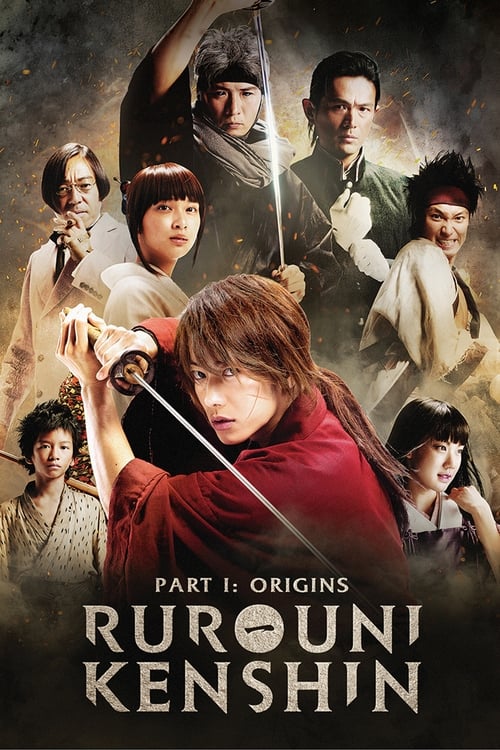
Rurouni Kenshin (2012) is a Japanese-language superhero film adapted from Manga, directed by Keishi Otomo and starring Takeru Satoh and Emi Takei. The film is a standalone production outside any shared cinematic universe and was released by Warner Bros. Japan. Audience rating: 7.7/10.
What is Rurouni Kenshin (2012) about?
A legendary assassin from Japan's civil war era now wanders as a pacifist rurouni, vowing never to kill again. He's drawn into a battle to protect a young woman's dojo. Based on Nobuhiro Watsuki's manga.
Released in 2012, Rurouni Kenshin was directed by Keishi Otomo and produced under the Warner Bros. Japan banner. The film occupies a significant place within the Independent — telling a self-contained story outside of shared-continuity superhero franchises.
The film features lead performances from Takeru Satoh, Emi Takei, Yû Aoi, among others, anchoring a story that adapts characters first brought to life in Manga. Its source material gives the film a foundation rooted in decades of published storytelling, which Otomo and the creative team interpret through a cinematic lens.
With an audience rating of 7.7, Rurouni Kenshin is generally praised as a strong entry in the superhero genre — its strengths in storytelling, performance, and production design regularly cited by viewers.
What happens in Rurouni Kenshin (2012)? — Full Plot
In 1878 Meiji-era Tokyo, Himura Kenshin (Takeru Satoh) — a former assassin known as the Battousai during the Bakumatsu civil war — has spent the last decade wandering Japan as a peaceful swordsman. Kenshin carries a sakabato (reverse-blade sword), with the blade reversed so it cannot kill, symbolising his vow to never take another life. He arrives in Tokyo to find the city plagued by a mysterious swordsman impersonating his old Battousai identity.
Kenshin meets Kamiya Kaoru (Emi Takei), the young heir to the Kamiya Kasshin-ryu sword school. Kaoru has been hunting the false Battousai who has been damaging her school's reputation. The false Battousai turns out to be Hajime Udo (Munetaka Aoki), a violent thug being supplied with opium by corrupt businessman Kanryu Takeda (Teruyuki Kagawa). Kenshin and Kaoru team up to expose the conspiracy.
Kanryu Takeda's primary business is opium manufacturing. He kidnaps Megumi Takani (Yu Aoi) and forces her to produce a particularly addictive opium variant called Spider's Web. Kenshin and Kaoru rescue Megumi from Kanryu's compound; the rescue triggers Kanryu's retaliation. The middle act consists of multiple sword battles as Kanryu's hired swordsmen pursue Kenshin's group.
Kanryu hires Jin-e Udo (Koji Kikkawa) — a genuinely skilled swordsman specialisizing in psychological warfare — to capture Kenshin. Jin-e kidnaps Kaoru as bait; Kenshin is forced to confront Jin-e at a temple to rescue her. Their duel features the franchise's most cinematic combat sequence; Kenshin nearly relapses to his Battousai identity but ultimately defeats Jin-e while honoring his no-kill vow.
The third act focuses on Kanryu's compound assault. Kenshin, accompanied by Sanosuke Sagara (Munetaka Aoki in a separate role) and his new allies, invades Kanryu's mansion to dismantle his opium operation permanently. The assault features extensive sword choreography across multiple combat sequences. Kanryu is captured and turned over to the Meiji government; Megumi is freed.
The film's epilogue establishes Kenshin's permanent place in Kaoru's dojo as her practical student-turned-protector. The franchise's tonal commitment to combining genuine sword combat with quiet character development is widely cited as one of its most distinctive creative choices. Kenshin's journey through Meiji-era Japan continues across the subsequent franchise films.
Who stars in Rurouni Kenshin (2012)?
Find Rurouni Kenshin (2012) on Amazon
Watch Rurouni Kenshin on Prime Video, browse the original Manga source material, and discover Blu-rays, soundtracks, and related merchandise on Amazon.
As an Amazon Associate, I earn from qualifying purchases. Link clicks do not affect editorial coverage — see our disclaimer.
What are some facts about Rurouni Kenshin (2012)?
Rurouni Kenshin released in 2012, placing it within the 2010s era of comic book cinema — a decade that saw superhero films become the dominant force at the global box office.
Directed by Keishi Otomo, the film was produced by Warner Bros. Japan and adapts source material from Manga.
The principal cast features Takeru Satoh and Emi Takei, with key supporting roles played by Yû Aoi, Munetaka Aoki.
The film belongs to Independent — an independent / standalone production, not tied to a shared cinematic universe.
Rurouni Kenshin carries an audience rating of 7.7 — putting it in the solid-to-excellent tier of the genre.
The Manga source material for Rurouni Kenshin has been in continuous publication for decades, giving filmmakers a rich well of storylines, character arcs, and iconography to draw upon.
Modern superhero films like this one use a mix of practical effects and digital VFX, with entire sequences often shot against volume walls or LED stages pioneered by shows like The Mandalorian.
Rurouni Kenshin is catalogued on Movies on Comics among our collection of 164 comic book films spanning 48 years of cinema — from Richard Donner's 1978 Superman to the present day.
💬 Reader Comments