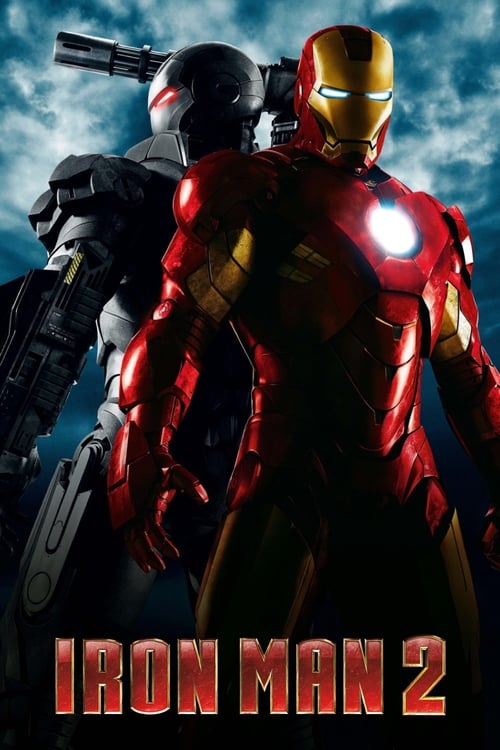
Iron Man 2 (2010) is a superhero film adapted from Marvel Comics, directed by Jon Favreau and starring Robert Downey Jr. and Gwyneth Paltrow. The film is part of the MCU and was released by Marvel Studios. Runtime: 2h 4m. Rated PG-13. Audience rating: 7.0/10.
What is Iron Man 2 (2010) about?
Tony Stark deals with the public fallout of his secret identity while facing a Russian physicist who uses his father's technology to exact revenge, and a rival weapons manufacturer.
Released in 2010, Iron Man 2 was directed by Jon Favreau and produced under the Marvel Studios banner. The film occupies a significant place within the MCU — contributing to the ongoing narrative and mythology of that cinematic universe.
The film features lead performances from Robert Downey Jr., Gwyneth Paltrow, Don Cheadle, among others, anchoring a story that adapts characters first brought to life in Marvel Comics. Its source material gives the film a foundation rooted in decades of published storytelling, which Favreau and the creative team interpret through a cinematic lens.
Its 7.0 rating reflects a film that divided audiences — appreciated for its ambition and spectacle by some, criticized for pacing and execution by others. Its place in the genre remains a frequent discussion point.
What happens in Iron Man 2 (2010)? — Full Plot
Moscow, Russia. A cramped apartment in a Soviet-era housing block. An old man in a stained undershirt is dying on a cot in the corner while a thirty-something man with prison tattoos sits at a kitchen table watching a small black-and-white television. On the TV: Tony Stark, in a Los Angeles press conference six months prior, in a black suit with a sling on his arm. "I am Iron Man." The room reverberates with the line. The old man — Anton Vanko — speaks his son's name with his dying breath. "Ivan. The world will know what you've made. They will know." Anton dies. Ivan goes into the bedroom and pulls out a battered file folder of yellowed blueprints — schematics his father drew with Howard Stark in 1962 for the original arc reactor, before Howard had Anton deported to a Siberian work camp for trying to sell the patent. Ivan starts building. He has a head of tools, a parrot, and twenty-five years of resentment. He's the Whiplash.
Six months later. Stark Industries' restored Stark Expo opens in Flushing Meadows, Queens — the same fairgrounds Howard Stark used for the 1974 Expo, restored at Tony's expense as a tribute to his late father. Tony arrives in an Audi R8 and walks out to the main stage to the J. Robert Spencer's brassy theme music, flanked by a chorus line of women in red-and-gold sequined leotards waving sparklers. He's wearing the Iron Man helmet, then takes it off mid-aisle. "I am not saying that the world is enjoying its longest period of uninterrupted peace because of me. I'm not saying that from the ashes of captivity… ha, ha… Anyway. Welcome." The crowd loves it. The crowd is also unaware that the man on stage is dying of palladium poisoning from his own chest reactor and has decided to put on the loudest, most public spectacle of his life because it might be his last.
Washington DC. The Senate Armed Services subcommittee. Senator Stern — wisp of hair, Garry Shandling's last great screen role — demands that Stark hand over the Iron Man weapon to the United States military. Justin Hammer, CEO of Hammer Industries and Tony's longest-running rival, testifies first against Stark in language that sounds like he wrote it himself. Lt. Colonel James Rhodes is brought up by the Air Force to read from a classified DoD threat assessment that names Iron Man as a destabilizing global asset. Stark, in a chair on the floor, takes a Bluetooth earpiece out of his pocket and hacks into the chamber's projection screens with his phone. He pulls up surveillance footage of Hammer's failed combat-suit prototypes — one in which an Iranian-program test pilot literally explodes inside a Hammer-built exoskeleton. Stark wins the hearing on the laugh alone. "You want my property — you can't have it. But I did you a big favor. I have successfully privatized world peace." He walks out flashing both V-signs at the room.
Back at the Malibu mansion, Tony tests his arc reactor's palladium core in a portable spectrometer. The white crystalline rim of the reactor's coil is yellowing at the edges — heavy-metal poisoning, the lethal byproduct of using palladium to channel his core's plasma. Stains on his neck. Black veins crawling up his collarbone. He's been quietly dying for weeks. JARVIS calculates his blood-palladium saturation at 47 percent and rising. There is no other element on the periodic table he can swap into the reactor that produces the same energy density. Tony reads the diagnostic, walks to the bar, and pours himself a tall glass of chlorophyll smoothie to suppress the symptoms. He decides not to tell anyone.
He decides instead to put his affairs in order. He hands Pepper Potts the Stark Industries CEO position — appointing her in a paperwork shuffle that walks through his offices over the course of one tense afternoon. To replace Pepper as his personal assistant, he interviews a redheaded notary from Stark Legal named Natalie Rushman. She speaks Latin, French, Italian, Russian, Greek; she takes him in three sentences during the interview; she pins a Stark employee to a sparring mat in five seconds when Happy challenges her in the boxing ring. She's Natasha Romanoff, undercover, on assignment from Nick Fury and SHIELD to assess whether Tony Stark himself is fit to be considered for an emerging initiative. Tony, dying and lonely and stubborn, hires her on the spot.
Monaco Grand Prix. Tony, sun-drunk and aware that this might be his last public appearance, decides at the last minute to bump the original Stark-team driver out and race the Historic GP himself. He's halfway through lap seven on the Circuit de Monaco when a tall figure in a stained jumpsuit walks calmly out onto the track holding two power-cables that crackle electric. The cables fire as electric whips, slashing the racing field. Ivan Vanko stands in the middle of the racetrack, his face screwed up in furious patience, swinging the whips down on car after car. He cuts Tony's Formula car in half lengthwise on a hairpin. Pepper, watching from the pit lane, runs onto the track with Happy and a briefcase Tony's been keeping in the back of every car for months. The briefcase opens. The Mark V suit assembles around Tony in six seconds, a deployable folding armor designed for emergencies. He climbs out of the wreckage in red and silver. Tony and Vanko fight on the racetrack with whips against repulsors for ninety seconds before Tony manages to seize the whip controllers and yank them apart with his hands. "You lose," Vanko says, smiling through bleeding teeth. "You lose." The Monaco Polizia arrests Vanko.
Vanko is in a Monaco holding cell for forty-eight hours before Justin Hammer breaks him out. Hammer has been watching the Monaco footage on cable news and has decided that Vanko is exactly the engineer he needs to compete with Stark for the upcoming Department of Defense weapons contract. He pays Vanko's bail through a shell intermediary, fakes Vanko's death in transit with a corpse double in a body bag, and smuggles Vanko on a private jet to a Hammer Industries black-site facility in the New Jersey marshes. Hammer wants Iron Man knockoff suits. Vanko, working in a warehouse with a parrot and a row of welding torches, builds him something better instead: unmanned drones controlled remotely by a single human operator. Six combat models. Air, sea, land, and three special-purpose. Hammer doesn't realize Vanko is engineering all six drones with a hidden Wireless override that he can take over personally at any time.
Tony's symptoms are accelerating. The black veins are at his jaw now. He has hours, maybe a day. He decides to throw a birthday party. The party gets out of hand quickly — he ends up drunk in the Mark IV suit DJing his own house, repulsor-blasting champagne bottles, shooting watermelons off a guest's head. Pepper is mortified. Rhodey, in dress blues, asks him to take it down a notch. Tony refuses. Rhodey walks into the back vault, grabs the Mark II prototype suit out of its stand, suits up himself, and walks out into the living room. The two of them — Iron Man and War Machine 0.0 — wreck Tony's house in a fifteen-minute armored brawl that flies through the kitchen, the indoor pool, the garage, and back to the living room. Rhodey ends up with the Mark II flying out a hole in the roof. He takes it to Edwards Air Force Base, where Hammer Industries has already been contracted to militarize it. The Mark II becomes War Machine.
Tony, drunk and dying and abandoned, sits in a Randy's Donuts in El Segundo at six AM eating a glazed cruller. Nick Fury walks into the donut shop and slides into the booth across from him. Tony stares. Natasha Romanoff steps in behind Fury and reveals her actual identity. Fury walks Tony through SHIELD's file on him — the palladium poisoning, the suicide note he's been writing on his garage walls, the autopsy reports SHIELD has been quietly preparing for him. Fury also walks him through the file on his father Howard Stark, who Tony has spent his whole adult life resenting as a distant alcoholic. Howard wasn't just a weapons manufacturer; he was one of SHIELD's three founders. Howard built the original 1943 Strategic Scientific Reserve with Peggy Carter and Anton Vanko. Howard and Anton invented the arc reactor in 1962 together — Anton tried to sell the patent, Howard had him deported to Siberia, and the rest of his life Howard regretted it but never said it out loud. Fury hands Tony a hand-stamped DOD case that turns out to contain Howard Stark's personal archives — every notebook, every blueprint, every reel of film Howard left in storage at SHIELD's Triskelion.
Tony brings the crates home and opens Howard's reels. He finds a 1974 promotional film Howard recorded for the original Stark Expo, in which Howard, in a suit, with a four-year-old Tony watching off-camera, addresses the future Tony directly. "Tony. You are, and will always be, the greatest creation of mine." Tony watches the line on loop for forty minutes. Then he notices something on the wall of the model Howard built for the same Expo film — a diorama Howard called "the city of tomorrow," with hidden geometric placements that don't fit any real architecture. He looks closer. Howard drew the unit cell of an undiscovered element into the diorama's hex-grid layout. The atomic number is 130. The diagram is a literal periodic-table entry for a new element. JARVIS scans it. The element is theoretically stable. The element can serve as a palladium replacement in the arc reactor with zero toxicity.
Tony spends the next forty-eight hours in his garage building a particle accelerator out of a scrap-yard collider donut from a 1970s lab Howard maintained, rigging it across his living room and forging the new element by literally smashing protons in his house. He synthesizes a tiny triangular core. He pops out the palladium core in his chest, slots the new one in. The black veins on his neck recede in real time. "That tastes like coconut. And metal." He's no longer dying. He's also now, finally, ready for the fight.
Stark Expo, finale night. Justin Hammer takes the main stage in a white suit to unveil his Hammer Drones — a dozen unmanned combat units in air, ground, and aquatic variants. The crowd is impressed. He calls Rhodey out next, in the militarized Mark II now repainted gray and matte, with shoulder-mounted Gatling guns and missile pods bolted on. Rhodey marches onstage in War Machine and the crowd loses it. Then Ivan Vanko's wireless override kicks in. The Hammer Drones go red-eyed and the War Machine suit Rhodey's wearing goes hostile too. Vanko has hijacked all of it from a control room two miles away. The drones turn on the Expo crowd and on Tony Stark — who's flying in from above in the Mark VI, the new chest core glowing white-blue — and the Expo park becomes a war zone with civilians fleeing through the food carts.
What follows is sixteen minutes of pure spectacle. Tony, Mark VI, and Rhodey, in the briefly-recovered War Machine (Tony deletes the override remotely mid-flight), fight side by side through every Hammer Drone variant — ground troops in the park, aerial drones in a dogfight over the Unisphere, naval drones rising out of the Flushing Bay. The two of them, finally working together, lock into a back-to-back symmetrical firing-stance and clear the air in a single long take that the entire Marvel franchise spent the next ten years referencing. Tony tells Rhodey "go for the head" — they synchronize repulsors and decapitate Vanko's command drone with a dual blast.
Vanko himself shows up at the Expo five minutes later wearing his own heavy-duty Whiplash suit — bigger than the Monaco rig, two arc-reactor-powered whips, mounted shoulder cannons, full armored plating. He fights Tony and Rhodey in a small concrete plaza beside the Unisphere globe sculpture. The fight is brutal, ungainly, and personal — Tony lands the kind of body blows you don't see in Marvel films again until the Russos take over. Vanko, finally caught between Tony and Rhodey at point-blank range, looks at both of them and smiles. "You lose." The Whiplash suit's reactor goes critical. He triggers a kill switch that activates self-destruct on every remaining Hammer Drone in the park, including the ones Pepper Potts is standing next to backstage. Tony flies through three exploding drones, catches Pepper off her feet, and flies her to the top of the Expo's tallest building — a hundred-and-fifty-foot scaffold-tower replica of the original Stark Expo Center — just as the drones go off below them.
On the rooftop, in the smoke of the burned-out park, Pepper finally quits as CEO. "I quit. I am resigning. Resignation accepted. Done." Tony pulls his helmet off. They lean in. He kisses her. She kisses him back. The film's actual ending — Tony Stark not as a tin-can-suit hero but as a man who's just been told he gets to keep living and now has to learn to be a person with someone — is two people sitting on a rooftop in their forties working out, awkwardly, that they're together. Phil Coulson, sliding into a black SUV with a SHIELD logo on the door, drives off into the night with a file marked NEW MEXICO. Cut to credits.
Post-credits. New Mexico desert. A SHIELD task force in tactical gear surrounds an impact crater in the middle of nowhere. A short, suit-and-tie SHIELD agent named Phil Coulson walks up to the edge of the crater and looks down. At the bottom of the hole, half-buried in the sand, is a stone hammer — squarish, ancient runes etched up its handle, a leather wrist-loop. Mjolnir. Coulson pulls out a cell phone. "Sir, we found it." Cut to black. Marvel just told the audience that the next movie out — Thor (2011) — is about gods. They're not kidding.
Who stars in Iron Man 2 (2010)?
Find Iron Man 2 (2010) on Amazon
Watch Iron Man 2 on Prime Video, browse the original Marvel Comics source material, and discover Blu-rays, soundtracks, and related merchandise on Amazon.
As an Amazon Associate, I earn from qualifying purchases. Link clicks do not affect editorial coverage — see our disclaimer.
What are some facts about Iron Man 2 (2010)?
Iron Man 2 released in 2010, placing it within the 2010s era of comic book cinema — a decade that saw superhero films become the dominant force at the global box office.
Directed by Jon Favreau, the film was produced by Marvel Studios and adapts source material from Marvel Comics.
The principal cast features Robert Downey Jr. and Gwyneth Paltrow, with key supporting roles played by Don Cheadle, Scarlett Johansson, Mickey Rourke.
The film belongs to MCU — the Marvel Cinematic Universe — the highest-grossing film franchise of all time.
Iron Man 2 carries an audience rating of 7.0 — putting it in the solid-to-excellent tier of the genre.
The Marvel Comics source material for Iron Man 2 has been in continuous publication for decades, giving filmmakers a rich well of storylines, character arcs, and iconography to draw upon.
Modern superhero films like this one use a mix of practical effects and digital VFX, with entire sequences often shot against volume walls or LED stages pioneered by shows like The Mandalorian.
Iron Man 2 is catalogued on Movies on Comics among our collection of 164 comic book films spanning 48 years of cinema — from Richard Donner's 1978 Superman to the present day.
Easter Eggs & Hidden Details in Iron Man 2 (2010)
Iron Man 2 was Marvel's first overstuffed sequel — too many subplots, too many setups for The Avengers. The deep cuts include Natasha Romanoff's hidden debut and the franchise's first major contractual dispute.
Terrence Howard played Lt. Col. James 'Rhodey' Rhodes in Iron Man (2008). Marvel and Howard had a contractual salary dispute during Iron Man 2 negotiations; Howard was fired. Don Cheadle replaced him for the franchise. Howard has publicly stated he was offered $40M and that Robert Downey Jr. negotiated his salary cut; RDJ has denied this account.
Scarlett Johansson's Natasha Romanoff is introduced as 'Natalie Rushman' — Tony Stark's new personal assistant. The cover identity is kept up through the first two acts. She is revealed as a SHIELD agent only when she fights through a Hammer Industries hallway in a single-take action sequence.
The blueprint of the 1974 Stark Expo that Tony uses to synthesize the new element contains an embedded Easter egg: hidden in the architectural diagram is the floor plan of what would become Avengers Tower in The Avengers (2012). Production designer J. Michael Riva planted it as a long-game continuity tease.
Sam Rockwell's Justin Hammer was a deliberate departure from the standard superhero villain archetype. Rather than a threatening genius, Hammer was portrayed as an incompetent businessman. The character has not returned in any subsequent MCU film.
Mickey Rourke went to Russia and visited actual Russian prisons to prepare for his role as Ivan Vanko / Whiplash. He learned Russian dialect for the role and incorporated real Russian-prison tattoo iconography into the character design.
Tony's synthesized new element to replace palladium is fictional. The element is unnamed in the film but is implied to be vibranium (the same metal as Cap's shield) in some Marvel continuity. The decision to leave the element unnamed was deliberate.
Tony's entrance at the Stark Expo with cheerleaders is set to AC/DC's 'Shoot to Thrill' — the same band's 'Back in Black' would later open Iron Man 3 (2013). The decision to use AC/DC tied the franchise to a specific rock-music identity.
Samuel L. Jackson's Nick Fury — only briefly in Iron Man (2008)'s post-credits — got significantly more screen time in Iron Man 2. The character's expanded role established the MCU's connective-tissue strategy.
The post-credits scene shows Phil Coulson investigating Thor's hammer Mjolnir in New Mexico — directly setting up Thor (2011). This was the franchise's first explicit post-credits MCU connection scene.
Iron Man 2 was widely cited as the franchise's first overstuffed sequel. Critics found it too focused on Avengers setup at the expense of character work. The film is now widely regarded as the moment Marvel realized franchise-bridging films could not be solo movies.
💬 Reader Comments