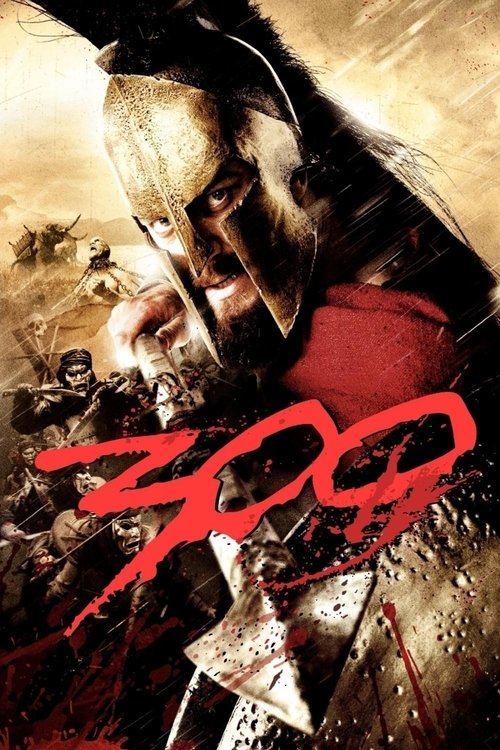
300 (2007) is a superhero film adapted from Dark Horse Comics, directed by Zack Snyder and starring Gerard Butler and Lena Headey. The film is part of the Dark Horse and was released by Warner Bros.. Runtime: 1h 57m. Rated R. Audience rating: 7.7/10.
📖 What is 300 (2007) about?
King Leonidas leads 300 Spartans to battle the massive Persian army of Xerxes I at the pass of Thermopylae, in a stand that would define the course of Western civilization.
Released in 2007, 300 was directed by Zack Snyder and produced under the Warner Bros. banner. The film occupies a significant place within the Dark Horse — contributing to the ongoing narrative and mythology of that cinematic universe.
The film features lead performances from Gerard Butler, Lena Headey, David Wenham, among others, anchoring a story that adapts characters first brought to life in Dark Horse Comics. Its source material gives the film a foundation rooted in decades of published storytelling, which Snyder and the creative team interpret through a cinematic lens.
With an audience rating of 7.7, 300 is generally praised as a strong entry in the superhero genre — its strengths in storytelling, performance, and production design regularly cited by viewers.
🎬 What happens in 300 (2007)? — Full Plot
⚠️ Heavy spoilers ahead. Forget what you've been told about comic-book adaptations sticking to Marvel and DC. 300 (2007) — Zack Snyder's adaptation of Frank Miller's graphic novel about the Battle of Thermopylae — is one of the most-stylized comic-book films ever made. The film grossed $456 million on a $65 million budget. Heavy spoilers ahead.
We open with narration from Dilios (David Wenham), a Spartan warrior who has lost his eye in battle. The film unfolds as Dilios's recounting of King Leonidas's last stand at the Battle of Thermopylae in 480 BCE. The narrative structure is canonically Frank Miller's foundational creative choice — the entire film is being narrated by a Spartan storyteller to a Spartan war-council, framed as a retrospective heroic narrative rather than as objective historical chronicle. The Spartan-narrator framing allows the film's intentional historical-inaccuracies (mythological-creature warriors, mystical Persians, supernatural-massive Persian armies) to be presented as canonically the storyteller's exaggerations rather than as historical claims.
The film's introduction establishes the canonical Spartan culture. Spartan male infants are inspected at birth — those with cosmetic-deformities are abandoned to die at the city walls. Survivors are removed from family homes at age 7 to begin formal military training. By age 18, they are full-status warriors. The cultural-context establishment is approximately 8 minutes of screen time and is widely cited as one of the most-effective single-cultural-introduction sequences in any 2000s film. The cinematography uses Frank Miller's foundational graphic-novel aesthetic — deeply-stylized lighting, hand-illustrated background tableau, deliberate use of slow-motion violence in the warrior-training sequences.
Cut to: 480 BCE. King Leonidas (Gerard Butler) is the king of Sparta. He receives a Persian emissary delivering an ultimatum from Xerxes I — surrender Sparta to Persian rule or face Xerxes's million-soldier army. Leonidas's response is the film's most-iconic single moment: he kicks the Persian emissary down a massive well at the center of the Spartan agora. The 'THIS IS SPARTA!' line — accompanied by the slow-motion kick — became one of the 2000s' most-meme'd cinematic moments. The line has been referenced across thousands of subsequent films, advertisements, and internet memes.
Leonidas, unable to formally declare war without the Spartan Council's approval (the Council includes religious leaders who have been bribed by Persian agents), leads 300 hand-picked Spartan warriors to confront Xerxes's army at the Thermopylae mountain pass. The 300 are canonically the most-elite warriors in Sparta — each individually-selected for both combat-skill and personal-loyalty to Leonidas. The march to Thermopylae is approximately 12 minutes of screen time; the cinematography emphasizes the Spartans' canonical-warrior discipline and the broader Greek landscape.
The 300 arrive at Thermopylae and immediately encounter Xerxes's advance force. The first day's engagement establishes the canonical 'phalanx' formation — interlocked Spartan shields creating a defensive wall, with spears extended through the shield-gaps for offensive thrust. The phalanx allows the Spartans to repel waves of Persian soldiers despite the substantial numerical disadvantage. The combat choreography combines slow-motion violence, hand-illustrated visual-effects backgrounds, and Frank Miller's canonical graphic-novel framing. Director Zack Snyder has stated in interviews that the phalanx-combat sequences were 'the most-meticulously-pre-visualized' single setpieces in his career.
Xerxes arrives at Thermopylae personally. He approaches Leonidas's command tent for a personal audience — the canonical 'God-King' Xerxes (Rodrigo Santoro) attempting to negotiate Leonidas's surrender through personal-charisma and the promise of regional autonomy under Persian rule. Leonidas refuses. Xerxes responds by deploying his army's most-elite forces — the Immortals (canonically the Persian Empire's elite warriors), giant elephants, and various exotic-creature warriors. The second day's combat is substantially more elaborate than the first day's; the choreography is approximately 25 minutes of continuous battle sequences.
Ephialtes (Andrew Tiernan) — a hunchbacked Spartan-born outcast whom Leonidas had refused to admit to the 300 due to his physical deformity — betrays Leonidas to Xerxes. He shows Xerxes a secret mountain path that allows the Persian army to bypass the Thermopylae chokepoint and encircle the Spartans. The betrayal is canonical to Frank Miller's source comic; the historical-Battle-of-Thermopylae actually was lost when a Greek named Ephialtes (the canonical historical figure) showed the Persian army the secret path. The film's depiction is therefore historically-grounded.
Leonidas faces the inevitable defeat. He sends Dilios back to Sparta as a messenger — Dilios will canonically recount the battle to the Spartan war-council and rally Sparta for the broader war against Persia. The remaining 300 Spartans prepare for their final stand. They die in a brutal final battle on the morning of the third day at Thermopylae. The final battle is approximately 18 minutes of screen time. Leonidas is killed by Persian arrows during a final attempt to assassinate Xerxes. The remaining 299 Spartans die alongside him.
The film's epilogue. Dilios delivers the news to Sparta. The Spartan war-council, hearing the canonical story of Leonidas's sacrifice, rallies a 10,000-warrior army for the larger war against Persia. The Battle of Thermopylae becomes Sparta's foundational rallying narrative. The film closes with Dilios leading the 10,000 Spartan army into a final battle against Xerxes at the Battle of Plataea — the canonical historical battle where the broader Greek alliance defeated the Persian Empire. The narrative thesis — that the 300 Spartans' sacrifice enabled the broader Greek victory — is canonically completed.
Commercial and critical reception. 300 grossed $456 million worldwide on a $65 million production budget — strong commercial success and one of 2007's biggest box-office hits. Critical reception was mixed (Rotten Tomatoes 60%); critics praised Zack Snyder's directorial style and the film's commitment to Frank Miller's source-comic aesthetic, but were divided on the film's depiction of Persian forces (which many critics felt slipped into orientalist stereotypes). The film's commercial success directly enabled Zack Snyder's broader Hollywood directorial career — without 300, there would be no Watchmen (2009), no Man of Steel (2013), no Snyder-led DCEU. The film also established the canonical 'graphic-novel direct adaptation' aesthetic that would inform multiple subsequent productions.
The 300 sequel and broader influence. 300: Rise of an Empire (2014) — a sequel set during the broader Greco-Persian Wars — was directed by Noam Murro and grossed $337 million worldwide. The sequel's commercial performance, while solid, has been canonically considered a substantial decline from the original. The 300 franchise has been retired since 2014; no third film has been announced. The original 300's broader cultural impact extends beyond superhero/comic cinema — the 'THIS IS SPARTA!' meme, the slow-motion-violence aesthetic, the phalanx-combat-choreography template, the deeply-stylized lighting approach — all have been canonically referenced across thousands of subsequent films, television series, and advertisements through the 2010s and into the 2020s.
Gerard Butler leads 300 as part of the Dark Horse continuity. The 2007 entry, directed by Zack Snyder, centres on the character Gerard Butler plays.
🎭
Lena Headey
Co-lead
Lena Headey's role in 300 (2007) is one of the project's two principal characters, drawn from the Dark Horse Comics canon.
🎭
David Wenham
Supporting cast
David Wenham appears in a supporting role in 300 (2007), playing a character from the Dark Horse Comics source material.
🎭
Rodrigo Santoro
Supporting cast
Rodrigo Santoro appears in 300 in a notable supporting capacity, playing a Dark Horse Comics character.
🛒 Find 300 (2007) on Amazon
Watch 300 on Prime Video, browse the original Dark Horse Comics source material, and discover Blu-rays, soundtracks, and related merchandise on Amazon.
As an Amazon Associate, I earn from qualifying purchases. Link clicks do not affect editorial coverage — see our disclaimer.
💡 What are some facts about 300 (2007)?
01
300 released in 2007, placing it within the 2000s era of comic book cinema — a decade that marked the modern superhero cinema revolution.
02
Directed by Zack Snyder, the film was produced by Warner Bros. and adapts source material from Dark Horse Comics.
03
The principal cast features Gerard Butler and Lena Headey, with key supporting roles played by David Wenham, Rodrigo Santoro.
04
The film belongs to Dark Horse — a distinct corner of comic book cinema.
05
300 carries an audience rating of 7.7 — putting it in the solid-to-excellent tier of the genre.
06
The Dark Horse Comics source material for 300 has been in continuous publication for decades, giving filmmakers a rich well of storylines, character arcs, and iconography to draw upon.
07
Films from this era combined practical stunts with the rising CGI industry — many sequences would be impossible with either technology alone.
08
300 is catalogued on Movies on Comics among our collection of 164 comic book films spanning 48 years of cinema — from Richard Donner's 1978 Superman to the present day.
🎮 Test Your Knowledge
📅Guess the Year
In what year was 300 released?
🎭Cast Quiz
Which of these actors did NOT star in 300?
🏛️Universe Match
300 belongs to which cinematic universe?
Plan Your Marvel & DC Watch
Complete guides to comic book movie release dates, chronological order, and the full timeline.
This page is part of our comprehensive comic-book cinema database. Plot summaries are written in our own original prose. Where we earn affiliate commissions through outbound links to streaming platforms, this is disclosed in our editorial standards.



💬 Reader Comments