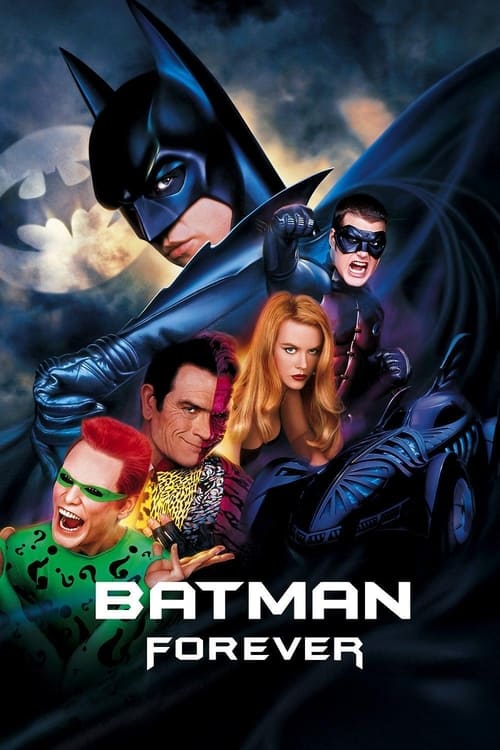
Batman Forever (1995) is a superhero film adapted from DC Comics, directed by Joel Schumacher and starring Val Kilmer and Tommy Lee Jones. The film is part of the DC Classic and was released by Warner Bros.. Audience rating: 5.4/10.
What is Batman Forever (1995) about?
Batman faces two eccentric villains — the coin-flipping Two-Face and the brilliant, mad Riddler — while also taking on a ward in Dick Grayson who becomes Robin.
Released in 1995, Batman Forever was directed by Joel Schumacher and produced under the Warner Bros. banner. The film occupies a significant place within the DC Classic — contributing to the ongoing narrative and mythology of that cinematic universe.
The film features lead performances from Val Kilmer, Tommy Lee Jones, Jim Carrey, among others, anchoring a story that adapts characters first brought to life in DC Comics. Its source material gives the film a foundation rooted in decades of published storytelling, which Schumacher and the creative team interpret through a cinematic lens.
The film's 5.4 audience rating indicates a mixed response. Even so, it holds interest as part of the broader DC Classic catalogue and for how it fits into the lineage of DC Comics-based cinema.
What happens in Batman Forever (1995)? — Full Plot
We open in Gotham. Two-Face / Harvey Dent (Tommy Lee Jones) — a former Gotham district attorney whose face was scarred by acid during a courtroom prosecution two years earlier — has been waging a personal vendetta against Batman for his role in the original courtroom-acid incident. Two-Face has been splitting his criminal operation across Gotham's organized-crime networks, using his signature two-headed coin to decide each operational decision. The opening Gotham bank heist sequence — Two-Face robs a Gotham Trust vault while Batman attempts to intervene — establishes the film's tonal-pivot from Tim Burton's gothic-darker register to Joel Schumacher's substantially-lighter aesthetic.
Bruce Wayne meets Dr. Chase Meridian (Nicole Kidman) — a Wayne Foundation-funded forensic psychiatrist who has been profiling Batman as a patient. She has been working with Gotham PD on the Two-Face manhunt. Chase is romantically drawn to Bruce immediately; she is also professionally fascinated by the psychological-profile of Batman that her research has been suggesting. She does not yet realize Bruce and Batman are the same person. Their professional-collaboration and romantic-tension develops across the film's middle act. Kidman was 28 years old at filming and was widely-cast based on her commercial-leading-actress credentials.
Edward Nygma (Jim Carrey) — a Wayne Industries researcher in the company's experimental cognitive-research division — has been working on a mind-reading helmet device. He has been seeking Bruce Wayne's personal sponsorship for his project. Bruce dismisses the request: the device would essentially allow corporate interests to harvest individual thoughts without consent. Nygma is fired by Bruce after he attempts to demonstrate the device against the corporate-ethics objection. Nygma decides to use the device for personal revenge against Bruce — and against Gotham broadly.
Nygma transforms into the Riddler — a green-spandex-suited supervillain whose specific aesthetic combines question-marks and electric-energy effects. He has been recruiting hired-criminal-staff to assist with his mind-reading-helmet rollout: a network of Gotham residents who voluntarily wear the helmet in exchange for monetary compensation. The helmet collects their broader thought-patterns; Nygma's central processing system harvests the collective-intelligence-data. He intends to use the collective-thought-harvesting to manipulate Gotham's broader political-and-corporate decision-making.
Meanwhile, Dick Grayson — a young circus-acrobat performer whose entire family (the Flying Graysons) was killed by Two-Face during a Gotham circus performance — has been taken in by Bruce. Bruce, recognizing Dick's parallel-trauma to his own parent-loss, has been mentoring him at Wayne Manor. Dick discovers Bruce's Batman identity through unauthorized exploration of the Batcave. He demands to become Batman's partner. Bruce initially refuses; Dick is too young, too emotionally-volatile, and too connected to his vengeance-motivation. Dick eventually wears him down through emotional-persistence.
Dick Grayson becomes Robin — Batman's protégé. The dynamic adds tonal lightness to the film. Robin's costume — red, green, and yellow — is deliberately-vibrant and visually-distinct from Batman's all-black aesthetic. The two-character partnership reshapes the film's broader tone: where Tim Burton's Batman duology had been characterized by Bruce's-solo-grief, Schumacher's Batman Forever introduces character-camaraderie that softens the franchise's broader emotional register. Bruce, mourning his parents and Dick's parents simultaneously, finally accepts his Batman role as therapeutic-grief-processing rather than vengeance-driven obsession.
Two-Face and the Riddler team up. They have been operating in parallel through the film's first act; their alliance is the mid-act-twist where their broader criminal operations canonically-converge. Together they kidnap Chase Meridian and trap Robin. The Riddler has been broadcasting his collective-intelligence-helmet rollout to Gotham residents via television commercials; the rollout has been generating substantial Gotham-public engagement (Riddler-helmet-ownership at 15%-of-Gotham-population by film's third act). The Riddler's specific operational-goal: replace Gotham-political-leadership with himself through the harvested-thought-intelligence.
The final battle features the Riddler's giant mind-reading apparatus on Claw Island — Riddler's specifically-engineered headquarters where the harvested-thought-intelligence is being processed. Batman and Robin infiltrate Claw Island. The choreography combines practical-stunt work (the island-set required substantial practical-construction) with extensive CGI augmentation (the mind-reading apparatus's specific visual effects). Two-Face has been waiting in the Claw Island laboratory with Chase Meridian held captive. The third-act battle is approximately 22 minutes of screen-time across multiple Claw Island locations.
Batman defeats the Riddler by using his own mind-reading helmet against him — the helmet's collective-intelligence-processing creates a feedback loop when applied to its inventor, overwhelming the Riddler's broader psychological capabilities. The Riddler is left in a permanent mental-breakdown state; he is institutionalized at Gotham's Arkham Asylum at the film's conclusion. Two-Face dies during the Claw-Island battle when his two-headed coin is intercepted by Batman during a decision-moment, causing Two-Face to canonically-fall to his death from a Claw Island platform.
The film closes with Batman accepting Robin as his permanent crime-fighting partner. Chase Meridian decides to keep their romantic-relationship private — she canonically-understands Bruce's psychological-need for the Batman-as-grief-therapy identity to continue. Chase remains in Gotham as Bruce's girlfriend across the broader Schumacher-Batman-franchise continuation. The film's final scene — Batman and Robin running into the Gotham night against the bat-signal-projection — has been canonically-referenced as the foundational image of Schumacher's Batman aesthetic.
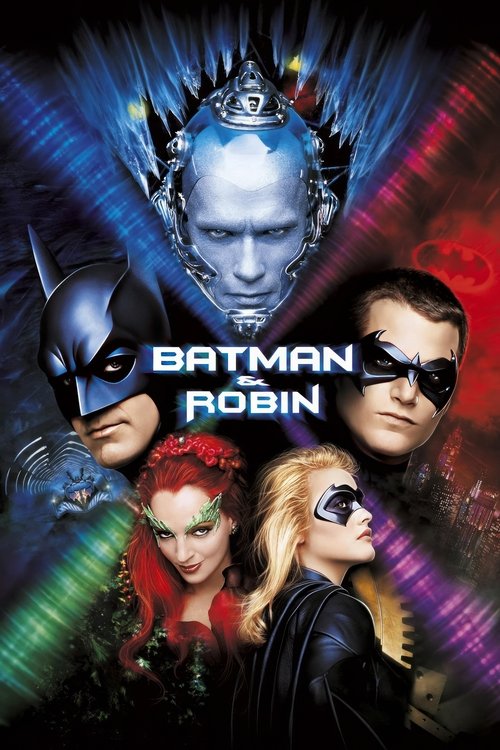
Commercial and critical reception. Batman Forever grossed $336 million worldwide on a $100 million production budget — strong commercial success and the franchise's highest-grossing pre-Nolan-era film. Critics responded mixed (Rotten Tomatoes 38%); reviewers generally praised the film's commercial-tonal-pivot from the Burton-darker aesthetic but criticized the narrative-coherence-issues. Val Kilmer's Batman performance was widely-criticized; Kilmer would decline to return for Batman & Robin (1997). The Schumacher-aesthetic established here would continue into Batman & Robin (1997) — which would prove substantially-more-catastrophic.
Who stars in Batman Forever (1995)?
Find Batman Forever (1995) on Amazon
Watch Batman Forever on Prime Video, browse the original DC Comics source material, and discover Blu-rays, soundtracks, and related merchandise on Amazon.
As an Amazon Associate, I earn from qualifying purchases. Link clicks do not affect editorial coverage — see our disclaimer.
What are some facts about Batman Forever (1995)?
Batman Forever released in 1995, placing it within the 1990s era of comic book cinema — a decade that experimented with tone and visual effects, paving the way for the modern era.
Directed by Joel Schumacher, the film was produced by Warner Bros. and adapts source material from DC Comics.
The principal cast features Val Kilmer and Tommy Lee Jones, with key supporting roles played by Jim Carrey, Nicole Kidman.
The film belongs to DC Classic — the classic DC film era — predating the connected-universe model.
Batman Forever carries an audience rating of 5.4 — a mixed reception that highlights the divisive nature of superhero film adaptations.
The DC Comics source material for Batman Forever has been in continuous publication for decades, giving filmmakers a rich well of storylines, character arcs, and iconography to draw upon.
Earlier comic book films relied heavily on physical sets, miniatures, and in-camera effects — the VFX approach modern audiences take for granted had not yet matured.
Batman Forever is catalogued on Movies on Comics among our collection of 164 comic book films spanning 48 years of cinema — from Richard Donner's 1978 Superman to the present day.


💬 Reader Comments